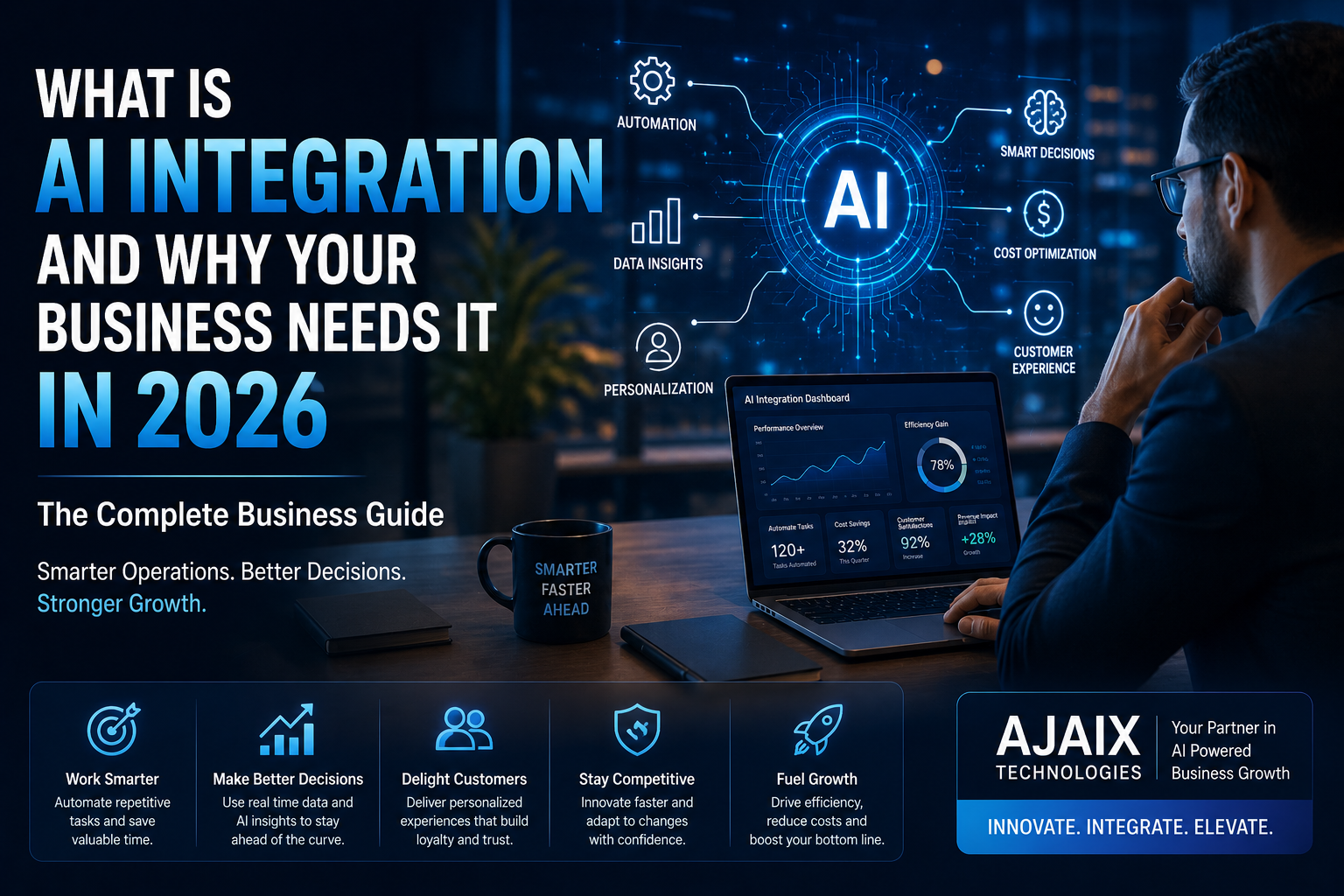
What Is AI Integration and Why Your Business Needs It in 2026
AI integration is no longer a luxury reserved for tech giants. Discover what it means to integrate AI into your business, the real-world benefits it delivers, and how to get started without the hype.
What Is AI Integration and Why Your Business Needs It in 2026
A few years ago, artificial intelligence was something businesses talked about in strategy sessions and left for someone else to implement. Today, that someone else has already implemented it — and they are pulling ahead.
AI is no longer a futuristic concept reserved for Silicon Valley giants or billion-dollar enterprises. It is a practical, accessible, and increasingly necessary layer of technology that businesses of every size are embedding into their operations, products, and customer experiences — right now.
The question is no longer whether AI will transform your industry. It already is. The question is whether your business will lead that transformation or scramble to catch up to competitors who started earlier.
This guide explains exactly what AI integration means in a real business context, what it can and cannot do, where it delivers the most measurable value, and how to approach implementation without falling for the hype.
Table of Contents
- What Is AI Integration?
- AI Integration vs. AI Automation: Understanding the Difference
- Why 2026 Is the Tipping Point for Business AI Adoption
- 8 Tangible Benefits of AI Integration for Businesses
- Real-World AI Integration Use Cases by Industry
- The Most Valuable AI Capabilities Businesses Are Using Today
- Common Mistakes Businesses Make with AI Integration
- How to Evaluate If Your Business Is Ready for AI Integration
- What a Successful AI Integration Project Looks Like
- Why Ajaix Technologies for Your AI Integration
- Frequently Asked Questions
1. What Is AI Integration? {#what-is-ai-integration}
AI integration is the process of embedding artificial intelligence capabilities — such as natural language processing, machine learning, computer vision, or predictive analytics — directly into your existing business software, workflows, and products.
It is not about replacing your entire technology stack with AI. It is about making your existing systems significantly smarter.
Here are a few concrete examples of what AI integration looks like in practice:
- Your customer support portal uses an AI-powered assistant to resolve 60% of enquiries without human involvement — and escalates the remaining 40% with full context already gathered
- Your e-commerce platform analyses purchase history and browsing behavior in real time to recommend products that each individual customer is most likely to buy
- Your HR system automatically screens incoming job applications against defined criteria, ranking candidates and flagging the strongest matches before a recruiter reviews a single CV
- Your financial reporting tool uses predictive models to forecast cash flow based on historical patterns, flagging potential shortfalls weeks before they become problems
- Your logistics platform optimizes delivery routes dynamically based on real-time traffic, weather, and order priority data
In every case, AI is not replacing your business — it is making your business faster, more accurate, and more capable than it was before.
2. AI Integration vs. AI Automation: Understanding the Difference {#ai-vs-automation}
These terms are often used interchangeably, but they describe different things — and the distinction matters when planning your investment.
Automation follows fixed rules. It executes a predefined sequence of steps when specific conditions are met. It is deterministic — the same input always produces the same output. Traditional business process automation (think: send an email when a form is submitted) is a form of automation.
AI integration introduces adaptive intelligence. AI systems learn from data, recognize patterns, make probabilistic decisions, and improve over time. They handle ambiguity, unstructured inputs, and situations that could not be fully anticipated when the rules were written.
In practice, the most effective implementations combine both. Automation handles the structured, repetitive workflow steps. AI handles the judgment calls, pattern recognition, and personalization that rule-based automation cannot manage.
| Automation | AI Integration | |
|---|---|---|
| Input handling | Structured, predefined | Structured and unstructured |
| Decision-making | Rule-based | Pattern-based, probabilistic |
| Adaptability | Fixed | Learns and improves over time |
| Best for | Repetitive, predictable tasks | Complex, variable, judgment-intensive tasks |
| Example | Auto-send invoice on order completion | Predict which customers are likely to churn |
3. Why 2026 Is the Tipping Point for Business AI Adoption {#why-2026}
The conversation around AI in business has been building for years — but 2026 marks a genuine inflection point for several converging reasons:
AI Capabilities Have Matured
The large language models, computer vision systems, and predictive analytics tools available today are qualitatively different from what existed even three years ago. They are more accurate, more reliable, more affordable, and far easier to integrate into existing software systems.
The Cost of Implementation Has Dropped Dramatically
What previously required a dedicated AI research team and millions in infrastructure investment can now be implemented through well-documented APIs, pre-trained models, and cloud-native AI services. The barrier to entry for meaningful AI integration has never been lower.
Your Competitors Are Already Moving
Across every industry, businesses that invested in AI integration early are now operating with measurably lower costs, faster response times, and more personalized customer experiences. The competitive gap between AI-enabled and non-AI-enabled businesses is widening every quarter.
Customer Expectations Have Shifted
Customers now expect the personalization, speed, and availability that AI makes possible. An e-commerce experience without intelligent recommendations, a support function without intelligent triage, or a service without predictive capability increasingly feels dated — and customers notice.
4. Eight Tangible Benefits of AI Integration for Businesses {#8-benefits}
1. Dramatically Reduced Operational Costs
AI handles high-volume, repetitive tasks at a fraction of the cost of human labor — without fatigue, errors, or time zone limitations. Businesses that automate document processing, customer triage, data entry, and reporting with AI consistently report significant cost reductions in those functions.
2. Faster, More Accurate Decision-Making
AI processes vastly more data than any human team can review, identifies patterns invisible to manual analysis, and surfaces insights in real time. Decisions that previously required days of data gathering and analysis can be made in seconds — with higher confidence.
3. Personalization at Scale
AI enables you to deliver individually tailored experiences — product recommendations, content, pricing, communications — to thousands or millions of customers simultaneously. Personalization at this scale is not humanly possible without AI.
4. 24/7 Customer Service Without 24/7 Staffing Costs
AI-powered customer assistants handle enquiries, resolve common issues, collect information, and escalate complex cases around the clock — without the overhead of shift coverage or the inconsistency of human fatigue.
5. Predictive Rather Than Reactive Operations
Instead of responding to problems after they occur, AI-powered systems anticipate them. Predictive maintenance flags equipment issues before failure. Churn prediction models identify at-risk customers before they leave. Demand forecasting prevents stockouts before they happen.
6. Accelerated Document and Data Processing
AI reads, classifies, extracts, and processes documents — invoices, contracts, applications, reports — at speeds and accuracy levels that no manual process can match. What takes a team days to process can be completed in minutes.
7. Enhanced Security and Fraud Detection
AI systems monitor transaction patterns, user behavior, and network activity in real time — flagging anomalies and potential threats far faster than rule-based security systems. Fraud detection, intrusion detection, and compliance monitoring all benefit significantly from AI integration.
8. Compounding Returns Over Time
Unlike a one-time operational improvement, AI systems that learn from your data get measurably better over time. The models trained on your business's historical data become increasingly accurate, and the competitive advantage they deliver compounds with every passing month.
5. Real-World AI Integration Use Cases by Industry {#use-cases-by-industry}
Retail and E-Commerce
- Personalized product recommendation engines driven by individual browsing and purchase history
- Dynamic pricing models that optimize margins based on demand, competition, and inventory levels
- Intelligent inventory forecasting that reduces overstock and stockout situations
- AI-powered visual search allowing customers to find products by uploading photos
Financial Services
- Automated loan application processing with AI-driven credit risk assessment
- Real-time fraud detection across transaction streams
- AI-powered financial planning tools that generate personalized portfolio recommendations
- Intelligent document processing for KYC, compliance, and audit workflows
Healthcare
- AI-assisted diagnostic support tools that flag anomalies in medical imaging
- Predictive patient risk scoring that enables proactive care intervention
- Automated appointment scheduling and patient communication systems
- Clinical documentation assistants that reduce administrative burden on medical staff
Logistics and Supply Chain
- Real-time route optimization based on traffic, weather, and delivery priority
- Predictive maintenance for fleet vehicles and warehouse equipment
- Demand forecasting models that align inventory with anticipated need
- Automated shipment tracking and exception management systems
Human Resources
- Intelligent CV screening and candidate ranking systems
- Employee sentiment analysis through engagement survey processing
- Predictive attrition models that identify flight-risk employees before resignation
- Automated onboarding workflows personalized to role and department
Professional Services
- AI-powered contract review and clause extraction tools
- Intelligent project scoping assistants that estimate effort from historical data
- Automated client reporting generation from raw data sources
- Knowledge management systems that surface relevant past work for current engagements
6. The Most Valuable AI Capabilities Businesses Are Using Today {#ai-capabilities}
Natural Language Processing (NLP)
The technology behind chatbots, document analysis, sentiment analysis, and voice interfaces. NLP enables software to understand, interpret, and generate human language — making it the foundation of customer-facing AI applications and document processing tools.
Machine Learning and Predictive Analytics
Algorithms that learn from historical data to forecast future outcomes — churn probability, demand levels, maintenance needs, fraud likelihood. Machine learning is the engine behind most predictive business intelligence tools.
Computer Vision
AI that interprets and analyses visual data — images, video, documents. Used in quality control, document processing, security systems, medical imaging, and retail analytics.
Large Language Models (LLMs)
The technology behind tools like GPT-4 and Claude — capable of generating human-quality text, summarizing documents, answering complex questions, writing code, and engaging in sophisticated conversation. LLMs are being integrated into everything from customer support systems to internal knowledge bases.
Recommendation Engines
Systems that analyse user behavior and preferences to surface relevant products, content, or actions. The most commercially impactful AI application in retail and media.
Robotic Process Automation with AI (Intelligent RPA)
Traditional RPA handles structured, rule-based tasks. Add AI and it can handle unstructured inputs, make judgment calls, and adapt to variations in the data it processes — dramatically expanding the range of automatable workflows.
7. Common Mistakes Businesses Make with AI Integration {#common-mistakes}
Knowing what to avoid is as important as knowing what to pursue. These are the most common and costly mistakes businesses make when approaching AI integration:
Chasing the Technology Instead of the Problem
AI is not a goal — it is a tool. Businesses that start with "we want to use AI" instead of "we want to solve this specific problem" tend to build impressive demos that deliver no operational value.
Underestimating Data Quality Requirements
AI is only as good as the data it learns from. Businesses with messy, incomplete, or siloed data cannot expect AI to compensate. Data preparation is often 60–70% of the effort in a real AI project — and it is frequently underestimated.
Skipping the Change Management Work
AI integration changes how people work. Without proper training, communication, and change management, even technically excellent AI implementations face low adoption and organizational resistance that undermine ROI.
Expecting Instant Results
AI systems, particularly those that learn from your data, improve over time. Realistic expectations about the maturation curve of AI-powered features are essential to maintaining organizational support through the early stages.
Treating AI as a One-Time Project
AI integration is an ongoing capability, not a one-time deployment. Models need monitoring, retraining, and updating as your business and its data evolve. Businesses that treat AI as a set-and-forget implementation consistently underperform those that treat it as a living system.
8. How to Evaluate If Your Business Is Ready for AI Integration {#are-you-ready}
Use this readiness checklist to assess where your business stands:
- ✅ You have a clearly defined business problem that AI could plausibly solve
- ✅ You have access to relevant historical data in reasonable volume and quality
- ✅ Your core business processes are documented well enough to be analyzed and mapped
- ✅ You have leadership buy-in for the investment and the change management it requires
- ✅ Your existing technology infrastructure can accommodate new integrations
- ✅ You have — or can access — the technical expertise to implement and maintain AI systems
- ✅ You can define measurable success criteria for the AI integration before it begins
If you can check five or more of these, you are well-positioned to move forward. If fewer than five apply, a discovery conversation with an experienced AI development partner will help you identify the gaps to address first.
9. What a Successful AI Integration Project Looks Like {#successful-project}
To ground this in reality, here is a representative example of how a well-executed AI integration delivers measurable business value:
The Business Challenge: A professional services firm was spending significant team hours each week manually reviewing and categorizing incoming client enquiries, routing them to the appropriate department, and generating initial response drafts. Response times averaged 48 hours and quality varied significantly depending on which team member handled the triage.
The AI Integration Solution: Ajaix Technologies integrated a natural language processing layer into the firm's existing client portal. Incoming enquiries were automatically classified by type and urgency, routed to the correct team, and accompanied by a pre-drafted response suggestion generated from the firm's historical response library. Complex or high-value enquiries were flagged for priority human review with full context already assembled.
The Measured Outcomes:
- Average response time reduced from 48 hours to under 4 hours
- Manual triage work eliminated for 75% of incoming enquiries
- Response consistency scores in client satisfaction surveys improved by 34%
- Senior staff time redirected from administrative triage to high-value client work
- Full ROI achieved within 8 months of deployment
This is what practical, well-scoped AI integration delivers — not science fiction, but measurable operational improvement.
10. Why Ajaix Technologies for Your AI Integration {#why-ajaix}
At Ajaix Technologies, we are a full-stack software development company based in Mansehra, Pakistan, specializing in high-performance web development, AI integration, and scalable enterprise architecture.
Here is what we bring to your AI integration project:
Problem-First Approach
We start every AI engagement by defining the business problem with precision — not by selecting a technology. This ensures that every AI capability we implement is connected to a measurable outcome your business actually cares about.
Full-Stack AI Development
We handle the complete integration stack: data pipeline design, model selection and fine-tuning, API development, frontend integration, deployment infrastructure, and ongoing monitoring. One accountable team across the entire project.
Practical Experience Across Industries
We have implemented AI-powered features for businesses across retail, professional services, logistics, and financial services — with a consistent focus on production-ready solutions that work in real operational environments, not just in demos.
Data Quality First
We invest properly in data assessment and preparation before any model work begins. This is the step most AI projects skip — and the reason most AI projects underdeliver.
Post-Deployment Support
AI systems require ongoing monitoring, retraining, and iteration. Our post-deployment support agreements ensure your AI integration continues to improve and perform long after the initial launch.
11. Frequently Asked Questions {#faq}
Do I need a large amount of data to get started with AI integration? It depends on the use case. Some AI capabilities — particularly those using pre-trained large language models — require very little of your own data to deliver value. Others, like predictive analytics trained on your specific business patterns, require meaningful historical data. A discovery conversation will clarify what applies to your situation.
Will AI replace my employees? The most effective AI implementations augment human work rather than replace it — handling high-volume, repetitive tasks so that your team can focus on the higher-value work that requires human judgment, creativity, and relationship. In most businesses, AI creates more valuable roles rather than eliminating them.
How long does an AI integration project take? Straightforward integrations using existing AI APIs can be delivered in 6–12 weeks. More complex custom model development and training projects typically run 3–6 months. A scoping conversation will give you a realistic timeline for your specific requirements.
How do I know which AI use case to start with? Start with the problem that costs your business the most time, money, or accuracy — and where you have reasonable data quality. High-volume, repetitive, judgment-intensive tasks are almost always the best starting point for measurable early ROI.
Is AI integration secure? It can be — if it is designed with security in mind from the start. This means careful management of the data used to train and run models, secure API design, access controls, and compliance with relevant data protection regulations. Security architecture is part of every AI integration project we deliver.
What happens if the AI makes a wrong decision? Well-designed AI integrations include human review checkpoints for high-stakes decisions, confidence thresholds that determine when human escalation is required, and monitoring systems that flag performance degradation. AI should amplify human judgment — not replace it in situations where errors carry significant consequences.
Ready to Put AI to Work in Your Business?
AI integration is not about chasing a trend. It is about equipping your business with capabilities that reduce costs, accelerate operations, and deliver experiences your competitors cannot match without making the same investment.
At Ajaix Technologies, we cut through the noise and build AI integrations that solve real business problems — with the engineering rigour, domain knowledge, and post-launch support to make them work in production, not just in a pitch deck.
Schedule a free AI integration discovery call with our team →
No jargon. No overselling. Just an honest conversation about where AI can deliver real value for your business — and how we can build it.
Ajaix Technologies — Engineering the Future. Based in Mansehra, Pakistan. Serving clients globally. ajaix.com · [email protected]