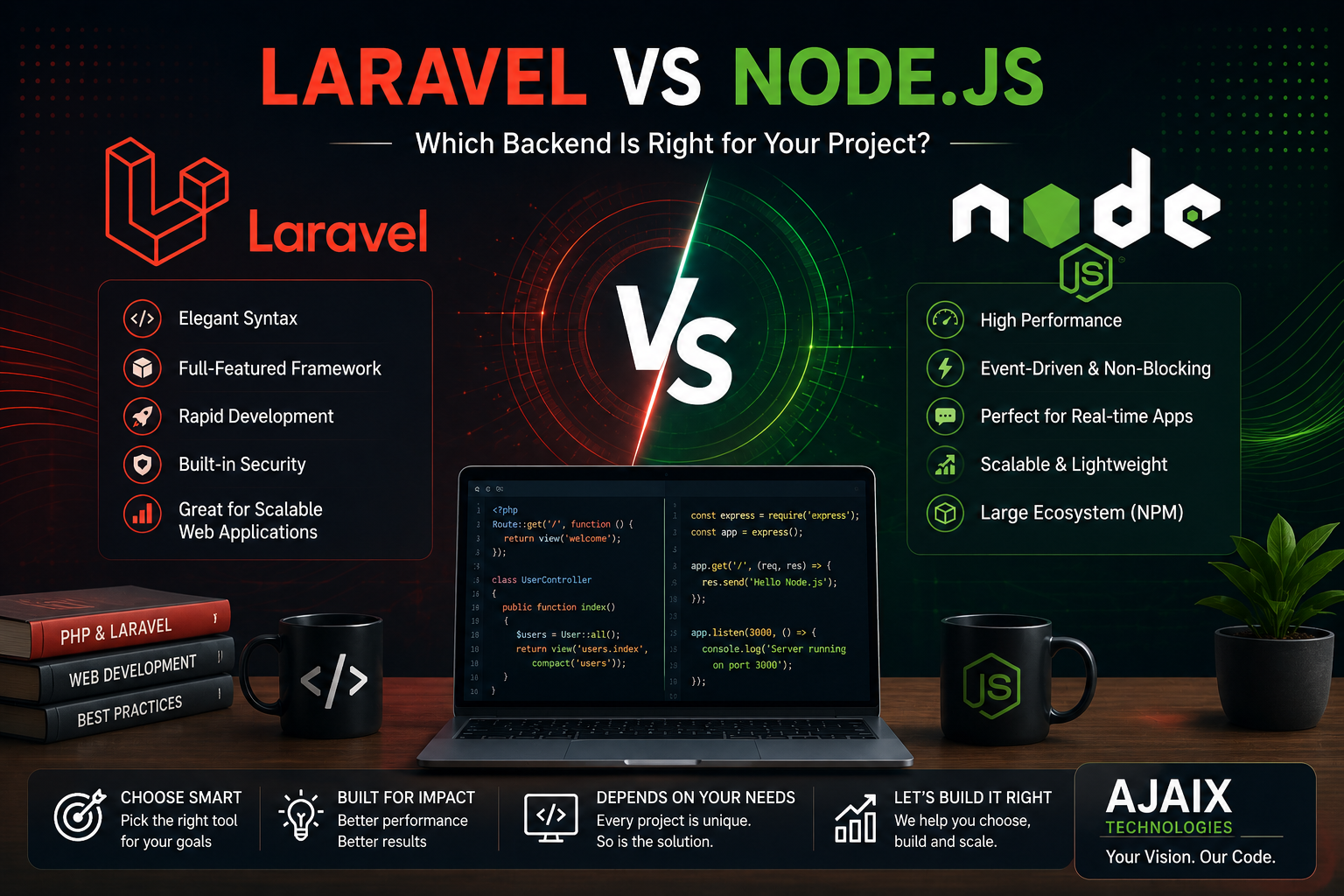
Laravel vs Node.js: Which Backend Is Right for Your Project in 2026?
Laravel and Node.js are two of the most popular backend technologies in the world — but they solve different problems. This guide breaks down the real differences so you can make the right choice for your project.
Laravel vs Node.js: Which Backend Is Right for Your Project in 2026?
Few technology decisions generate more debate in development teams than the choice of backend framework. And when the shortlist comes down to Laravel and Node.js, the debate gets particularly heated — because both are genuinely excellent choices that power production applications at massive scale.
The problem is that most comparisons approach this question the wrong way. They focus on benchmarks, language wars, and tribal preferences rather than the only question that actually matters: which one is the right fit for your specific project?
This guide gives you a clear, honest comparison of Laravel and Node.js across every dimension that matters to a real project — architecture, performance, developer experience, ecosystem, scalability, and total cost of development. By the end, you will know exactly which to choose and why.
Table of Contents
- What Is Laravel?
- What Is Node.js?
- Laravel vs Node.js: The Core Architectural Difference
- Performance and Scalability Compared
- Developer Experience and Learning Curve
- Ecosystem, Libraries, and Community
- Security Out of the Box
- Database and ORM Support
- API Development: REST and GraphQL
- Real-Time Features and WebSockets
- When to Choose Laravel
- When to Choose Node.js
- Side-by-Side Comparison Table
- What Ajaix Technologies Recommends
- Frequently Asked Questions
1. What Is Laravel? {#what-is-laravel}
Laravel is a PHP web application framework built on the MVC (Model-View-Controller) architectural pattern. First released in 2011 by Taylor Otwell, it has grown into the most popular PHP framework in the world — with a rich ecosystem, an opinionated structure, and an exceptional developer experience that made PHP productive and enjoyable again after years of reputation damage.
Laravel ships with a comprehensive set of built-in tools:
- Eloquent ORM for expressive, intuitive database interaction
- Artisan CLI for scaffolding, migrations, and automation
- Blade templating engine for server-rendered views
- Laravel Sanctum and Passport for API authentication
- Laravel Queues for background job processing
- Laravel Echo and Reverb for real-time event broadcasting
- Laravel Horizon for queue monitoring
- Laravel Telescope for application debugging and monitoring
Laravel follows the philosophy of convention over configuration — it makes the right decisions for you upfront, so your team spends time building features rather than configuring infrastructure.
2. What Is Node.js? {#what-is-nodejs}
Node.js is a JavaScript runtime environment built on Chrome's V8 engine that allows JavaScript to run on the server side. Released in 2009 by Ryan Dahl, Node.js fundamentally changed backend development by enabling full-stack JavaScript — the same language on both the frontend and the server.
Node.js itself is not a framework — it is a runtime. The most common frameworks and tools built on top of it include:
- Express.js — Minimal, unopinionated web framework (the most widely used)
- Fastify — High-performance alternative to Express
- NestJS — Opinionated, TypeScript-first framework inspired by Angular
- Hapi.js — Enterprise-focused framework with strong built-in validation
- Prisma / Sequelize / TypeORM — ORM options for database interaction
Node.js is built around a non-blocking, event-driven architecture — meaning it handles many concurrent connections efficiently without spawning a new thread for each one. This makes it particularly well-suited to I/O-intensive, real-time, and high-concurrency applications.
3. Laravel vs Node.js: The Core Architectural Difference {#core-architectural-difference}
Understanding the architectural difference between these two technologies is essential — because it explains why each excels in different scenarios.
Laravel: Synchronous, Batteries-Included MVC
Laravel follows a traditional synchronous request-response model. Each incoming HTTP request is handled sequentially — processed, interacted with the database, and responded to. This model is predictable, easy to reason about, and extremely well-suited to the CRUD-heavy, form-driven, database-centric applications that make up the vast majority of business software.
Laravel's opinionated structure means there is a Laravel way to do almost everything — and that consistency makes large teams productive and codebases maintainable.
Node.js: Asynchronous, Non-Blocking Event Loop
Node.js processes requests asynchronously using an event loop. Rather than waiting for one operation to complete before starting the next, it registers a callback and moves on — handling thousands of concurrent connections on a single thread without blocking.
This architecture is exceptionally efficient for applications where the bottleneck is I/O — waiting for database queries, external API responses, or file system operations — rather than CPU computation.
The trade-off is complexity. Asynchronous code requires more careful management, and Node.js's unopinionated nature means architectural decisions that Laravel makes for you must be made explicitly by your team.
4. Performance and Scalability Compared {#performance-and-scalability}
This is the section where most comparisons go wrong — by treating performance as a single dimension. In practice, which technology performs better depends entirely on what you are asking it to do.
Raw Throughput and Concurrency
In benchmarks measuring raw request throughput and concurrent connection handling, Node.js consistently outperforms Laravel. Its non-blocking event loop is simply more efficient at handling high volumes of simultaneous, I/O-bound requests on equivalent hardware.
For applications where tens of thousands of simultaneous connections are the norm — chat platforms, real-time dashboards, streaming APIs — Node.js's architectural advantage is real and significant.
Complex Business Logic and Database-Heavy Applications
For applications dominated by complex database interactions, business rule processing, and form handling — the typical enterprise web application — the performance difference between Laravel and Node.js narrows considerably. Laravel's Eloquent ORM is highly optimized, and its query builder generates efficient SQL. For these workloads, both technologies scale comfortably to handle substantial production traffic.
Scalability Approach
Both technologies scale horizontally — deploy more instances behind a load balancer as traffic grows. Laravel applications typically scale through additional PHP-FPM processes and queue workers. Node.js applications scale through additional process instances managed by tools like PM2 or container orchestration platforms like Kubernetes.
Neither technology imposes a fundamental ceiling on scalability. The architecture of your application and the quality of your database design matter far more than the choice of backend framework.
5. Developer Experience and Learning Curve {#developer-experience}
Laravel
Laravel is widely regarded as one of the best developer experiences in any programming ecosystem. Its documentation is exceptional — comprehensive, well-maintained, and genuinely readable. Its conventions mean that developers familiar with Laravel can work productively on any Laravel codebase with minimal orientation.
The learning curve for PHP developers transitioning to Laravel is gentle. For developers coming from other languages, PHP itself adds a layer of unfamiliarity — but Laravel's abstractions insulate most developers from PHP's rougher edges.
For teams building traditional web applications with server-rendered views or REST APIs, Laravel's built-in tools cover nearly every common requirement out of the box — reducing the time spent researching, evaluating, and integrating third-party packages.
Node.js
Node.js has a steeper initial learning curve — not because JavaScript is harder than PHP, but because Node.js is deliberately unopinionated. Your team must make explicit architectural decisions that Laravel makes for you: which framework to use, which ORM to adopt, how to structure middleware, how to handle validation, how to manage authentication.
This flexibility is genuinely valuable for experienced teams building non-standard architectures. It is a productivity drain for teams that would benefit from sensible defaults and a clear, established way of doing things.
TypeScript has become the de facto standard for serious Node.js projects, adding type safety that catches errors at compile time — but also adding build tooling complexity that Laravel projects do not require.
For organizations where JavaScript already dominates the frontend, Node.js offers the significant advantage of language consistency across the full stack — reducing context switching and enabling code sharing between frontend and backend.
6. Ecosystem, Libraries, and Community {#ecosystem}
Laravel Ecosystem
Laravel's ecosystem is mature, cohesive, and commercially supported. First-party packages cover most common requirements — authentication, payments (Laravel Cashier), search (Laravel Scout), file storage, notifications, and more — and they integrate seamlessly because they are designed to work together.
The community is large, active, and productive. Laravel conferences, extensive YouTube and written tutorial content, and a thriving package ecosystem (via Packagist) mean that solutions to common problems are rarely more than a search away.
Node.js Ecosystem
Node.js has the largest package ecosystem in software development — npm hosts over two million packages covering virtually every imaginable use case. This abundance is both a strength and a challenge.
The strength: there is almost certainly a package for what you need. The challenge: evaluating package quality, maintenance status, security posture, and compatibility requires ongoing diligence. The npm ecosystem has historically had issues with abandoned packages, dependency chain vulnerabilities, and quality inconsistency that Laravel's more curated Packagist ecosystem largely avoids.
That said, the Node.js community is enormous, and frameworks like NestJS have brought increasing cohesion and opinionated structure to the ecosystem for teams that want it.
7. Security Out of the Box {#security}
Laravel
Security is one of Laravel's genuine strengths. Out of the box, Laravel protects against the most common web vulnerabilities by default:
- CSRF protection on all state-changing requests
- SQL injection prevention through parameterized queries in Eloquent
- XSS protection through Blade's automatic output escaping
- Mass assignment protection through fillable/guarded model properties
- Secure password hashing using bcrypt or Argon2 by default
- Authentication scaffolding with secure session management included
For teams without deep security expertise, Laravel's defaults provide a strong baseline that is difficult to accidentally circumvent.
Node.js
Node.js applications are as secure as their implementation. With Express — the most commonly used framework — almost nothing is secure by default. Security headers, CSRF protection, input sanitization, and SQL injection prevention all require deliberate implementation through appropriate middleware and libraries.
This is not a criticism of Node.js — it is a reflection of its unopinionated philosophy. Experienced Node.js teams implement robust security practices. Less experienced teams sometimes leave gaps that Laravel would have closed automatically.
NestJS, with its more opinionated structure, provides a stronger security baseline than bare Express and is worth considering when Node.js is the right architectural choice for a security-sensitive application.
8. Database and ORM Support {#database-and-orm}
Laravel: Eloquent ORM
Eloquent is Laravel's built-in ORM and is genuinely one of the best in any framework ecosystem. Its ActiveRecord implementation makes database interaction expressive and readable:
// Fetch active users with their orders, sorted by registration date
$users = User::where('status', 'active')
    ->with('orders')
    ->orderBy('created_at', 'desc')
    ->get();
Laravel's migration system provides version-controlled database schema management. Its query builder handles complex queries with a clean, chainable API. Database seeding and factories make test data generation straightforward.
Eloquent supports MySQL, PostgreSQL, SQLite, and SQL Server natively. MongoDB support is available through a first-party package.
Node.js: Multiple ORM Options
Node.js does not have a single standard ORM — which means choosing one is an additional decision your team must make. The main options are:
- Prisma — Type-safe, schema-first ORM with excellent TypeScript integration. The current community favourite for new projects.
- Sequelize — Mature, widely used, but showing its age in API design.
- TypeORM — Decorator-based ORM inspired by Java's Hibernate. Well-suited to NestJS projects.
- Drizzle — Lightweight, SQL-centric ORM gaining popularity for its performance and simplicity.
Each has different trade-offs in terms of API design, performance, migration tooling, and TypeScript support. For teams without strong existing preferences, the choice adds decision overhead that Laravel eliminates.
9. API Development: REST and GraphQL {#api-development}
Both Laravel and Node.js are excellent choices for building REST APIs and GraphQL services — with some notable differences in the out-of-the-box experience.
REST APIs
Laravel's API resource classes, route model binding, and request validation make REST API development exceptionally clean and productive. Authentication via Sanctum (token-based) or Passport (full OAuth2) is well-documented and straightforward to implement.
Node.js with Express or Fastify is equally capable for REST API development — and its non-blocking architecture gives it a throughput advantage at very high concurrency levels. NestJS provides a more structured, decorator-driven approach that resembles Laravel's conventions for teams that prefer explicit architecture.
GraphQL
Both ecosystems have solid GraphQL support. Laravel uses the Lighthouse package — a schema-first GraphQL server that integrates tightly with Eloquent and feels native to the Laravel ecosystem.
Node.js has Apollo Server, Pothos, and Mercurius (for Fastify) — all mature, production-proven GraphQL implementations. The Node.js GraphQL ecosystem is arguably more active and diverse than Laravel's.
10. Real-Time Features and WebSockets {#real-time-features}
This is where Node.js holds its clearest architectural advantage.
Real-time features — live notifications, collaborative editing, chat, live data dashboards, multiplayer functionality — require maintaining persistent connections with many simultaneous clients. Node.js's event-driven, non-blocking architecture handles this natively and efficiently. Libraries like Socket.io and ws make WebSocket implementation straightforward.
Laravel has made significant strides in this area with Laravel Reverb (a first-party WebSocket server) and Laravel Echo (a JavaScript library for consuming real-time events). For applications where real-time features are a secondary concern — notifications, live updates — Laravel's real-time capabilities are now genuinely solid.
For applications where real-time interaction is the primary product — the core value delivered to users — Node.js remains the stronger architectural choice.
11. When to Choose Laravel {#when-to-choose-laravel}
Laravel is the right choice when:
- Your application is database-driven and CRUD-heavy — content management, e-commerce, CRM, ERP, booking systems, admin dashboards
- You want maximum out-of-the-box productivity — authentication, queues, notifications, file storage, and more are built in and work together seamlessly
- Your team is PHP-experienced or you want a framework that enables less experienced developers to be productive quickly
- Security and conventions matter more than architectural flexibility — Laravel's defaults protect you; its conventions keep large teams aligned
- You are building a monolithic or traditional MVC application — Laravel's architecture is optimized for this pattern
- You need a proven, mature framework for a long-lived enterprise application — Laravel's stability and long-term support record are excellent
12. When to Choose Node.js {#when-to-choose-nodejs}
Node.js is the right choice when:
- High concurrency is a core requirement — thousands of simultaneous connections, real-time data, or streaming functionality
- Real-time interaction is central to your product — chat applications, collaborative tools, live dashboards, multiplayer systems
- Your team is JavaScript-first — language consistency across the full stack reduces context switching and enables code sharing
- You are building microservices — Node.js's lightweight footprint and fast startup times make it well-suited to microservice architectures
- You need maximum flexibility in your architecture — Node.js's unopinionated nature gives experienced teams the freedom to build non-standard solutions
- Your API must handle extreme throughput — for raw request-per-second benchmarks, Node.js has an architectural edge
13. Side-by-Side Comparison Table {#comparison-table}
| Factor | Laravel | Node.js |
|---|---|---|
| Language | PHP | JavaScript / TypeScript |
| Architecture | Synchronous MVC | Asynchronous Event Loop |
| Opinionation | High (conventions included) | Low (you decide) |
| Out-of-the-box features | Extensive | Minimal (framework-dependent) |
| Learning curve | Moderate | Moderate to steep |
| Raw concurrency | Good | Excellent |
| Real-time support | Good (via Reverb) | Excellent (native) |
| Database / ORM | Eloquent (built-in, excellent) | Multiple options (Prisma recommended) |
| Security defaults | Strong | Requires explicit implementation |
| API development | Excellent | Excellent |
| Full-stack language unity | No | Yes (JavaScript everywhere) |
| Ecosystem maturity | Mature and cohesive | Massive but variable quality |
| Best for | Business apps, CRMs, e-commerce | Real-time, microservices, high-concurrency APIs |
| Long-term maintainability | Excellent | Good (framework-dependent) |
14. What Ajaix Technologies Recommends {#what-we-recommend}
At Ajaix Technologies, we work with both Laravel and Node.js in production — and our recommendation is always driven by the specific requirements of the project, not by framework loyalty.
In practice, our guidance comes down to this:
Choose Laravel if you are building a data-driven business application, need to move fast with a proven set of conventions, or are prioritizing long-term maintainability and team productivity over architectural flexibility. The majority of enterprise web applications we build use Laravel — because it is the right tool for the job most often.
Choose Node.js if real-time functionality is central to your product, you are building a high-concurrency API, your team is deeply JavaScript-first, or you need the architectural freedom to build something non-standard. We use Node.js — typically with NestJS or Fastify — for microservices, real-time platforms, and performance-critical APIs.
In many enterprise architectures, you do not have to choose. A Laravel monolith handling your primary application logic alongside a Node.js service handling real-time events is a common, sensible architecture — using each technology where it genuinely excels.
The most important thing is to make this decision based on your requirements — not based on which technology is generating more buzz this quarter.
15. Frequently Asked Questions {#faq}
Is Laravel faster than Node.js? Node.js has higher raw throughput in concurrency-heavy benchmarks. For typical business application workloads — database queries, business logic, form processing — the practical performance difference is negligible. Both scale well to handle substantial production traffic.
Can Laravel handle real-time applications? Yes — Laravel Reverb and Echo provide solid real-time capabilities for most use cases. For applications where real-time interaction is the core product rather than a supporting feature, Node.js remains the stronger architectural choice.
Which is better for REST API development? Both are excellent. Laravel provides more out-of-the-box structure for API development. Node.js with NestJS or Fastify matches Laravel's capabilities with higher throughput at extreme concurrency levels.
Is Node.js harder to learn than Laravel? Both have moderate learning curves. Laravel's learning curve is shaped by PHP familiarity and framework conventions. Node.js's learning curve is shaped by asynchronous programming concepts and the need to make architectural decisions Laravel makes for you.
Which technology is better for long-term projects? Laravel has an exceptional track record for long-term maintainability — its conventions keep large codebases organized and its upgrade path is well-managed. Node.js projects built on stable, opinionated frameworks like NestJS are similarly maintainable. Bare Express applications have a higher risk of architectural drift over time.
Can I switch from one to the other later? Technically yes — but it is expensive and disruptive. Make the right choice upfront with proper discovery and scoping rather than planning to switch later.
Not Sure Which Is Right for Your Project?
Choosing between Laravel and Node.js is a decision worth getting right — and it is one where the specifics of your project matter enormously. The wrong choice does not make your project impossible, but the right choice makes it significantly faster, cheaper, and more maintainable.
At Ajaix Technologies, our team works with both technologies daily. We are happy to review your project requirements, ask the right questions, and give you a clear, honest recommendation — with no agenda beyond helping you build something that works.
Book a free technical consultation with the Ajaix Technologies team →
No commitment. No pressure. Just a straightforward technical conversation about your project.
Ajaix Technologies — Engineering the Future. Based in Mansehra, Pakistan. Serving clients globally. ajaix.com · [email protected]