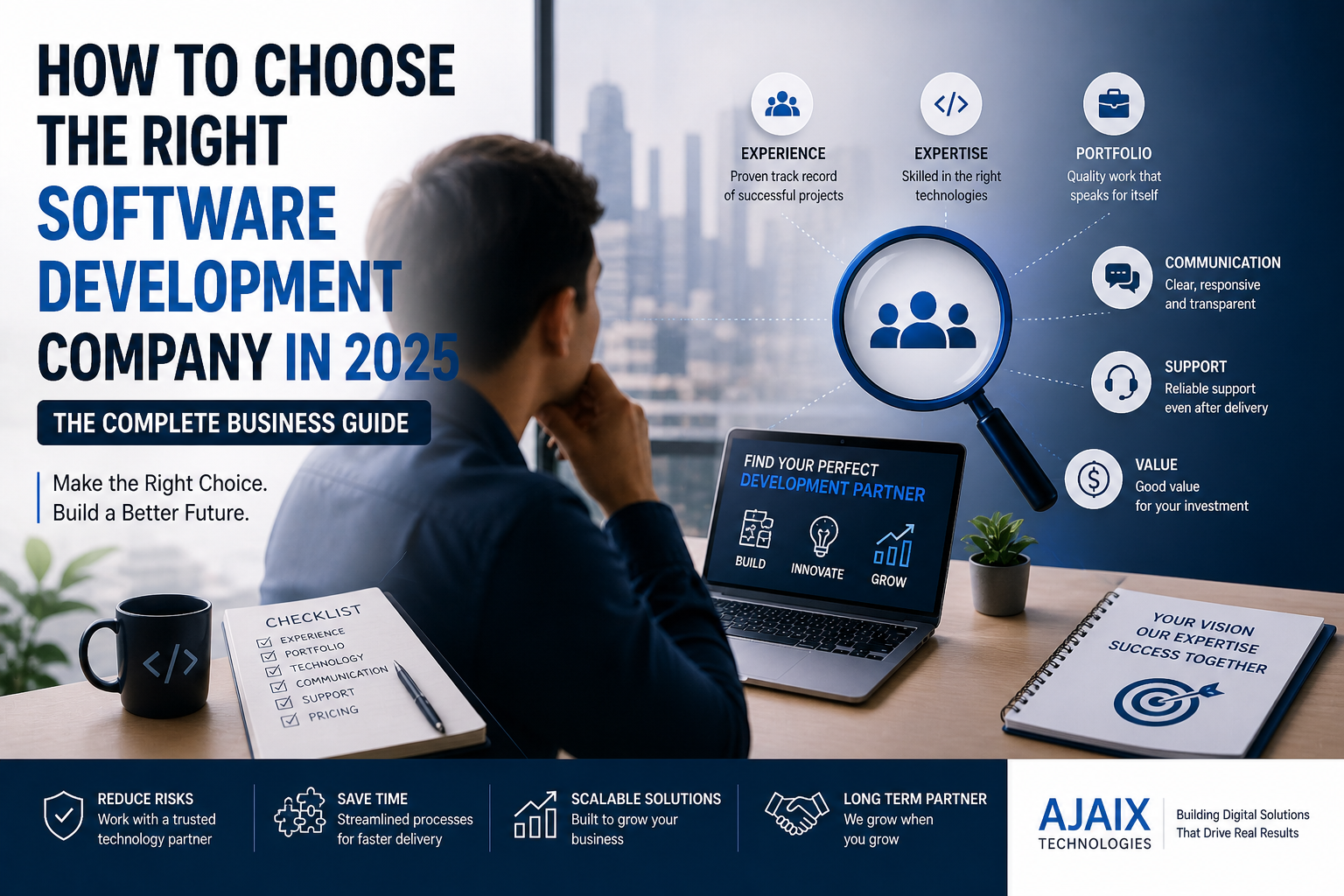
How to Choose the Right Software Development Company in 2026: The Complete Business Guide
Choosing the wrong software development company can cost your business years and thousands of dollars. This guide gives you the exact framework to evaluate, shortlist, and select a development partner that delivers real results.
How to Choose the Right Software Development Company in 2026: The Complete Business Guide
Choosing a software development company is one of the highest-stakes decisions a business leader will make. Get it right and you gain a long-term technology partner that accelerates your growth. Get it wrong and you are looking at missed deadlines, blown budgets, unusable software, and the painful process of starting over — sometimes years later.
The problem is that almost every development company looks credible on the surface. Polished websites. Impressive case studies. Confident sales calls. The real differences only become visible once the contract is signed — which is exactly too late.
This guide gives you a practical, no-nonsense framework for evaluating software development companies before you commit. Whether you are building your first custom web application, replacing legacy software, or launching a digital product, these criteria will help you find a partner that genuinely delivers.
Table of Contents
- Why Choosing the Wrong Company Is So Costly
- Define What You Actually Need Before You Start Looking
- Types of Software Development Companies Explained
- 10 Criteria to Evaluate Any Software Development Company
- Red Flags to Watch Out For
- Questions to Ask Before Signing Any Contract
- Onshore vs Nearshore vs Offshore: What Actually Matters
- How to Read a Software Development Proposal
- The Discovery Phase: Why It Separates Good Companies from Great Ones
- Why Ajaix Technologies Is the Right Partner for Your Business
- Frequently Asked Questions
1. Why Choosing the Wrong Company Is So Costly {#why-choosing-wrong-is-costly}
Before diving into how to choose well, it is worth understanding what is at stake when you choose poorly.
Failed or troubled software projects are not rare. Businesses of all sizes — from startups to large enterprises — regularly experience:
- Budget overruns of 50–200% due to poor scoping, hidden costs, and change order exploitation
- Delayed launches by 6–18 months that cost market opportunity and internal credibility
- Unusable software that was built to spec but not to purpose — technically delivered but operationally worthless
- Abandoned projects where a vendor disappears, goes out of business, or simply stops responding
- Code quality so poor it cannot be maintained, extended, or handed off without a full rewrite
Beyond the direct financial loss, there is the opportunity cost: the months your team spent managing a failing project instead of running your business, and the competitive ground you lost while waiting for software that never arrived.
Choosing the right software development company from the start is not just a procurement decision — it is a strategic one.
2. Define What You Actually Need Before You Start Looking {#define-what-you-need}
The single biggest mistake businesses make when searching for a development partner is starting the search before they have clarity on what they need. Vague briefs attract vague proposals — and vague proposals lead to misaligned expectations.
Before reaching out to any company, get clear on the following:
Problem, Not Solution
Define the business problem you are solving, not just the technical solution you think you need. "We need a mobile app" is a solution assumption. "Our field technicians spend 3 hours per day on manual paperwork that delays billing by a week" is a problem statement — and a much better starting point for a productive partnership.
Scope and Must-Have Features
What does the software absolutely need to do at launch? What is a nice-to-have for a later phase? A prioritized feature list helps development companies give you accurate estimates and helps you identify which ones actually read your brief.
Technical Constraints
Do you have existing systems the new software must integrate with? Compliance requirements (GDPR, HIPAA, PCI-DSS) that must be met? Preferred cloud platforms or technology stacks? Existing infrastructure that must be preserved?
Timeline and Budget Range
You do not need exact numbers, but you should have a realistic range. A company that can deliver what you need in 6 months for your budget is a very different conversation from one that requires 18 months and double your range. Knowing this upfront saves everyone's time.
Success Criteria
How will you know the project was successful? Define this before the project starts — not after. Measurable outcomes (reduction in processing time, increase in conversion rate, elimination of manual data entry) give both sides a clear target.
3. Types of Software Development Companies Explained {#types-of-companies}
Not all development companies are built the same. Understanding the different models helps you find the right fit for your specific situation.
Full-Service Development Agencies
End-to-end partners that handle everything from strategy and design to development, deployment, and ongoing support. Best for businesses that want a single accountable partner across the entire project lifecycle.
Specialist Boutiques
Companies that focus deeply on a specific technology, industry, or type of application — mobile apps, fintech platforms, healthcare systems, etc. Best when your project requires deep domain expertise in a narrow area.
Freelancer Networks and Marketplaces
Platforms that connect businesses with individual freelancers or small teams. Can be cost-effective for simple, well-defined projects but introduce coordination risk and accountability gaps on complex builds.
Nearshore and Offshore Development Firms
Companies based in different countries or time zones that offer cost advantages while maintaining professional team structures. Quality varies enormously — due diligence is critical.
Product Studios
Companies that operate as co-founders or product partners, typically taking equity or revenue share in exchange for development. Best for early-stage startups building a core product.
For most growing businesses commissioning custom business software, a full-service development agency with relevant industry experience is the most reliable choice.
4. Ten Criteria to Evaluate Any Software Development Company {#10-criteria}
Use this framework to systematically evaluate every company you consider. Score each criterion on a 1–5 scale and compare totals to remove emotion from the decision.
Criterion 1: Relevant Portfolio and Case Studies
Does the company have demonstrable experience building software similar to what you need — in terms of complexity, industry, or technology? Case studies should include real business outcomes, not just screenshots of finished products.
Criterion 2: Technical Depth and Stack Expertise
Does the team have genuine expertise in the technologies your project requires? Ask for specifics. A company that claims to "work with everything" often masters nothing. You want specialists in the stack that fits your project.
Criterion 3: Discovery and Scoping Process
How does the company move from your initial brief to a detailed project plan? Companies that skip discovery and jump straight to a fixed-price quote are skipping the work that determines whether that quote is remotely realistic.
Criterion 4: Communication and Project Management
How does the team communicate during a project? What tools do they use? How often do clients get updates? What is the escalation path when something goes wrong? Poor communication is the leading cause of project failure — more than technical problems.
Criterion 5: Code Quality and Engineering Standards
Ask about their approach to code reviews, automated testing, documentation, and version control. A company that cannot articulate its engineering standards clearly likely does not have robust ones.
Criterion 6: Security Practices
How is security handled in their development process? Do they conduct threat modelling? How are secrets and credentials managed? What happens in the event of a vulnerability discovery post-launch? Security should be built in, not bolted on.
Criterion 7: Post-Launch Support and Maintenance
What happens after the application goes live? Do they offer structured support agreements? What are their SLAs for bug fixes and incident response? Software without a support plan is a liability, not an asset.
Criterion 8: Intellectual Property and Code Ownership
All source code, design assets, and documentation created during your project should be owned entirely by you upon completion. Confirm this explicitly in any contract before signing.
Criterion 9: Client References
Ask to speak directly with two or three past clients — ideally on projects similar to yours. Pay close attention to how they describe the company's communication, problem-solving, and delivery against original commitments.
Criterion 10: Cultural and Operational Fit
Does this company feel like a genuine partner or a vendor processing a ticket? The best development relationships are collaborative — where the company brings ideas and challenges assumptions rather than simply executing instructions.
5. Red Flags to Watch Out For {#red-flags}
Even experienced buyers get caught out by companies that present well but perform poorly. Watch for these warning signs early in the evaluation process:
- No discovery phase offered. Any company willing to quote a fixed price without deeply understanding your requirements is either guessing or planning to charge you for the difference later.
- Vague or templated proposals. If the proposal could have been written for any client without reading your brief, it was.
- Reluctance to provide client references. Legitimate companies are proud of their work and happy to connect you with satisfied clients.
- Unusually low pricing. Below-market quotes are almost always recovered through change orders, scope disputes, or quality shortcuts.
- No clear IP ownership clause. If a company is evasive about who owns the code, walk away.
- Overpromised timelines. A company that quotes delivery in half the time of every other bidder is not more efficient — they are less honest about what the project actually involves.
- Senior staff in sales, junior staff in delivery. Ask specifically who will be working on your project day-to-day — not just who presents in the pitch meeting.
- No test coverage or quality assurance process. Software without automated testing is software waiting to break in production.
6. Questions to Ask Before Signing Any Contract {#questions-to-ask}
These questions cut through polished presentations and reveal how a company actually operates:
On process:
- Walk me through exactly how you handle a project from kickoff to launch.
- What happens when we discover mid-project that the scope needs to change?
- How do you manage quality assurance and testing throughout the build?
On the team:
- Who specifically will be working on my project, and what are their backgrounds?
- Will my project have a dedicated project manager or account contact?
- What is your team's availability and capacity during our project period?
On past work:
- Can you share a case study where a project ran into serious problems? What happened and how did you resolve it?
- Can you connect me with a client whose project was similar to mine in complexity?
On commercial terms:
- How do you handle change requests and additional scope?
- What does your post-launch support agreement look like, and what does it cost?
- What are the exact IP and code ownership terms in your standard contract?
On technical approach:
- What technology stack are you recommending for my project, and why?
- How do you handle security in your development process?
- How will you ensure the application performs at scale?
The quality of answers to these questions reveals far more than any portfolio or proposal.
7. Onshore vs Nearshore vs Offshore: What Actually Matters {#onshore-vs-offshore}
Location is one of the most debated factors in software development partner selection — and one of the most overrated ones. Here is a more useful way to think about it:
What actually matters is not where the company is located. What matters is communication quality, time zone overlap, engineering standards, and accountability structures — all of which vary far more within regions than between them.
There are exceptional development companies in every part of the world, and poor ones everywhere too. A development firm in Pakistan, Eastern Europe, or Latin America with strong processes, senior engineers, and a track record of enterprise delivery will outperform a local agency with junior staff and no structured methodology every time.
That said, here are the practical considerations:
- Time zone overlap matters for real-time collaboration. Aim for at least 4 hours of shared working hours with your development team.
- Language and communication clarity matters more than accent. Look for companies with strong written communication skills and structured reporting.
- Legal jurisdiction matters if your project involves sensitive data, contracts, or compliance requirements that benefit from shared legal frameworks.
- Cost efficiency matters — but only when it comes with quality. The cheapest option is rarely the most cost-effective one when total cost of ownership is considered.
8. How to Read a Software Development Proposal {#how-to-read-a-proposal}
Most business leaders are not trained to evaluate technical proposals. Here is what to look for:
Does It Reflect Your Brief?
A good proposal references your specific requirements, your business goals, and your stated constraints. A generic proposal is a signal that the company did not invest in understanding your situation.
Is the Scope Clearly Defined?
Every feature, integration, and deliverable should be explicitly named. Vague scope language like "standard user management" or "basic reporting" will be interpreted narrowly when disputes arise.
Is the Pricing Model Transparent?
Fixed-price projects provide budget certainty but require a detailed scope. Time-and-materials projects provide flexibility but require trust and strong project governance. Understand which model is being proposed and why.
What Is Included Post-Launch?
Does the proposal include a warranty period? Bug fix coverage? Transition to a support retainer? The post-launch plan reveals how seriously the company takes long-term partnership.
What Are the Payment Milestones?
Payment tied to delivery milestones protects you. A company asking for 50% upfront before any work is completed should be scrutinized carefully.
9. The Discovery Phase: Why It Separates Good Companies from Great Ones {#discovery-phase}
The discovery phase — sometimes called a scoping workshop or technical discovery — is the period before development begins where the team deeply analyses your requirements, maps your existing systems, validates technical assumptions, and produces a detailed project specification.
Great development companies treat discovery as essential, not optional. Here is why:
- It surfaces requirements you did not know you had
- It identifies integration complexities before they become expensive surprises
- It produces a shared specification that protects both parties from scope disputes
- It gives you a much more accurate timeline and budget estimate
- It reveals how the company thinks, communicates, and solves problems — before you are committed to a long engagement
Some companies offer paid discovery engagements. This is a healthy signal — it means they take the process seriously enough to staff it properly, and it gives you a low-risk way to evaluate the team before committing to a full build.
If a company skips discovery and goes straight to a full project proposal, ask yourself: how can they accurately scope something they have not yet properly understood?
10. Why Ajaix Technologies Is the Right Partner for Your Business {#why-ajaix}
At Ajaix Technologies, we are a full-stack software development company based in Mansehra, Pakistan — engineering scalable, secure, and high-performance web applications for businesses across industries and geographies.
Here is how we meet the criteria that matter:
Transparent Discovery Process
Every engagement begins with a structured discovery phase. We map your requirements, challenge assumptions, identify risks early, and produce a detailed specification before a single line of production code is written.
Full-Stack Technical Depth
Our team covers the complete technology stack — frontend, backend, database architecture, cloud infrastructure, DevOps, and security. No subcontracting critical work to unknown parties.
Business-First Thinking
We measure success by business outcomes, not lines of code delivered. Our recommendations are driven by what solves your problem most effectively — not by what is technically fashionable or easiest to build.
Clear IP Ownership
All source code, design assets, and documentation created during your project belong entirely to you. No ambiguity. No lock-in.
Post-Launch Partnership
Our relationship does not end at launch. We offer structured support retainers, iterative development cycles, and long-term technical partnership as your business grows and your software evolves.
Honest Communication
We give you realistic timelines, flag problems early, and tell you what you need to hear — not what you want to hear. In software development, honest communication is not a soft skill. It is the difference between a project that succeeds and one that does not.
11. Frequently Asked Questions {#faq}
How much does it cost to hire a software development company? Costs vary significantly by scope, complexity, and the company's location and seniority. The most important thing is to understand total cost of ownership — including post-launch support — rather than focusing solely on the initial build cost.
How do I know if a company's portfolio is genuine? Ask to speak with the clients featured in the portfolio. Legitimate companies welcome this. Also ask for the company's specific role on each project — some agencies claim ownership of work that was largely done by a client's internal team.
What is the difference between a software development company and a freelancer? A development company provides a structured team, project management, quality assurance, and accountability. A freelancer provides individual capacity. For complex, multi-month projects, a company structure significantly reduces delivery risk.
Should I choose a local company or consider international options? Location matters less than communication quality, engineering standards, and track record. Some of the world's best development teams are based outside Western markets — and deliver at significantly better value. Evaluate on merit, not geography.
What if my project needs change after development starts? Change is inevitable in software projects. Ask any company you evaluate how they handle scope changes before you sign. A clear, fair change request process is a sign of a mature organization.
How long does a typical software project take? Simple applications: 2–4 months. Mid-complexity business applications: 4–8 months. Complex enterprise platforms: 8–18 months. These ranges assume a structured discovery phase precedes development.
What should I do if a project goes wrong mid-way? Escalate early. The longer a troubled project continues without intervention, the more expensive the resolution. Document all communications, identify the root cause clearly, and if necessary, bring in an independent technical advisor to assess the situation objectively.
Ready to Find a Development Partner You Can Actually Trust?
You now have the framework to evaluate any software development company with confidence — and the knowledge to avoid the costly mistakes that derail so many projects before they begin.
At Ajaix Technologies, we welcome the scrutiny. Ask us the hard questions. Request references. Demand clarity on scope, ownership, and process. We have built our reputation on delivering exactly what we commit to — and on building the kind of long-term partnerships that grow with our clients.
Schedule a free discovery call with the Ajaix Technologies team →
No pressure. No generic pitch. Just an honest conversation about your project and whether we are the right fit to deliver it.
Ajaix Technologies — Engineering the Future. Based in Mansehra, Pakistan. Serving clients globally. ajaix.com · [email protected]