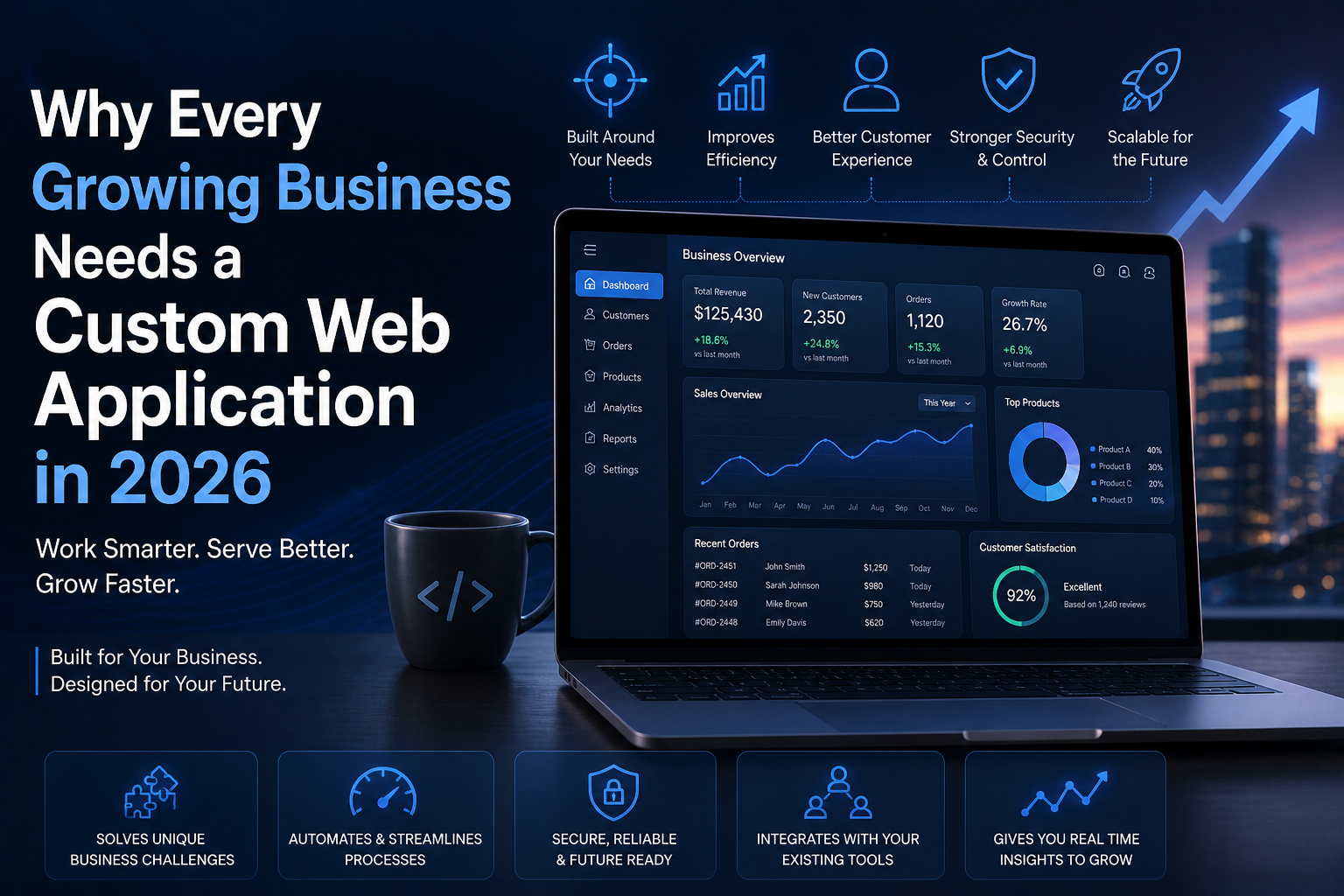
Why Every Growing Business Needs a Custom Web Application in 2026
Off-the-shelf software is holding your business back. Discover why custom web applications are the smartest investment growing businesses can make in 2026 — and how to get started.
Why Every Growing Business Needs a Custom Web Application in 2026
You started with spreadsheets. Then came the SaaS subscriptions — one for project management, one for invoicing, one for CRM, one for reporting. Before long, your team is toggling between six different tools, manually copying data from one platform to another, and paying monthly fees that add up to more than a full-time salary.
Sound familiar?
This is the hidden cost of generic software — and it is one of the most common reasons businesses plateau just when they should be scaling. In 2026, the companies pulling ahead are not the ones with the most SaaS subscriptions. They are the ones that invested in a custom web application built specifically for how their business actually operates.
In this post, we break down exactly why custom web applications matter, what they unlock for growing businesses, and how to know when you are ready to make the move.
Table of Contents
- What Is a Custom Web Application?
- The Problem with Off-the-Shelf Software
- 7 Reasons Your Business Needs a Custom Web App
- Industries That Benefit Most from Custom Web Apps
- Custom Web App vs. SaaS: A Side-by-Side Comparison
- Common Business Problems a Custom Web App Solves
- What Does It Cost to Build a Custom Web Application?
- How to Know If Your Business Is Ready
- Why Choose Ajaix Technologies as Your Development Partner
- Frequently Asked Questions
1. What Is a Custom Web Application? {#what-is-a-custom-web-application}
A custom web application is a software solution built from the ground up to serve the specific needs of your business — not the average needs of thousands of businesses in your industry.
Unlike off-the-shelf tools such as Salesforce, Trello, or QuickBooks, a custom web app is designed around your exact workflows, your data structure, your team's roles, and your customers' expectations. It runs in a web browser, requires no installation, and can be accessed securely from anywhere — making it ideal for modern, distributed teams.
Custom web applications can range from internal tools (employee portals, inventory management systems, reporting dashboards) to customer-facing platforms (client portals, booking systems, e-commerce platforms, SaaS products).
What they share in common: they do exactly what your business needs, and nothing more.
2. The Problem with Off-the-Shelf Software {#the-problem-with-off-the-shelf-software}
Generic software is built to serve the widest possible audience. That is its strength as a product — and its fatal weakness as a business tool for you.
Here is what happens when you try to run a unique business on generic software:
You Adapt Your Business to the Software — Not the Other Way Around
Every workaround, every manual step, every process that exists because "the software doesn't support it" is a tax on your team's time and energy. Over weeks and months, these workarounds compound into serious operational drag.
Data Lives in Silos
When your CRM does not talk to your billing system, and your billing system does not talk to your project tracker, someone is manually bridging those gaps every single day. That is not a workflow — it is a vulnerability.
You Pay Forever Without Building Equity
SaaS subscriptions are operational expenses. Every month you pay, you own nothing. A custom web application is a capital asset — it grows in value as it becomes more deeply integrated into your operations, and it belongs entirely to you.
You Hit Ceilings
User limits. Storage caps. Features locked behind higher pricing tiers. Export restrictions. API rate limits. Every growing business eventually hits the walls that generic software imposes — usually at the worst possible time.
3. Seven Reasons Your Business Needs a Custom Web App {#7-reasons-your-business-needs-a-custom-web-app}
1. It Is Built Around How You Actually Work
A custom web application models your real business logic — your approval chains, your pricing rules, your reporting hierarchies, your exception handling. There are no workarounds because the software was designed for your exact process from day one.
2. It Integrates Everything into One Place
Custom applications are built with integration in mind. Whether you need to connect to an existing ERP, a third-party payment gateway, a logistics API, or a government data system, a skilled development team builds the bridges that eliminate manual data transfer permanently.
3. It Scales with Your Business
As your user base grows, your transaction volume increases, and your team expands, a well-architected custom application scales with you. There are no per-seat fees, no storage upgrade prompts, and no vendor negotiations — just infrastructure that grows on demand.
4. It Gives You a Competitive Advantage
When your core operational software is unique to your business, competitors cannot replicate your workflow by subscribing to the same tool. Your custom application becomes part of your competitive moat — a proprietary system that delivers value your competitors simply cannot match.
5. It Protects Your Data
Generic SaaS platforms store your sensitive business data on shared infrastructure under terms that may not meet your compliance, privacy, or sovereignty requirements. A custom web application can be hosted on infrastructure you control, with security policies your team defines.
6. It Eliminates Redundant Subscriptions
Most businesses using multiple SaaS tools are paying for overlapping features across several platforms. A custom application consolidates these into a single system — often paying for itself within two to three years purely through subscription savings.
7. It Delivers Exactly the User Experience Your Team and Customers Deserve
Generic tools are designed for the average user. Your team is not average — and neither are your customers. A custom application delivers an interface, a feature set, and a user experience that is optimized for the people who use it every day, reducing training time and improving adoption.
4. Industries That Benefit Most from Custom Web Applications {#industries-that-benefit-most}
While virtually any business can benefit from a custom web application, certain industries see particularly high returns on this investment:
Healthcare and Medical Services
Patient management portals, appointment scheduling systems, telemedicine platforms, and compliance-driven record-keeping tools all require levels of customization, security, and regulatory compliance (HIPAA) that generic software rarely delivers adequately.
Financial Services and Fintech
Custom loan origination systems, investment dashboards, automated reporting platforms, and client portals built for financial services firms require deep integration, audit trails, and security standards that off-the-shelf software cannot consistently provide.
Logistics and Supply Chain
Route optimization tools, real-time shipment tracking platforms, warehouse management systems, and supplier portals built on custom web applications eliminate the data gaps that plague logistics operations relying on disconnected tools.
Real Estate and Property Management
Property listing platforms, tenant portals, lease management systems, and maintenance request workflows are highly specific to each organization's operational model — making custom development the clear choice.
Education and E-Learning
Learning management systems, student portals, assessment platforms, and institutional reporting dashboards require custom architectures that align with specific curricula, user roles, and data privacy regulations.
Manufacturing and Engineering
Production tracking systems, quality control dashboards, equipment maintenance logs, and procurement platforms built around a manufacturer's specific processes deliver operational efficiencies that no generic ERP can match out of the box.
5. Custom Web App vs. SaaS: A Side-by-Side Comparison {#custom-vs-saas}
| Factor | Custom Web Application | Off-the-Shelf SaaS |
|---|---|---|
| Ownership | You own it entirely | Vendor owns it |
| Customization | Unlimited | Limited to vendor's options |
| Integration | Built to your spec | Dependent on vendor APIs |
| Cost Model | One-time build + maintenance | Recurring subscription |
| Scalability | Scales on your terms | Subject to vendor pricing tiers |
| Data Control | Full control | Shared infrastructure |
| Security | Defined by you | Defined by vendor |
| Competitive Edge | High — unique to your business | Low — available to all competitors |
| Long-term ROI | Appreciates over time | No equity built |
| Support | Dedicated partner | Shared support queues |
The pattern is clear: for businesses with unique workflows, growth ambitions, and data sensitivity, custom web applications win on almost every dimension that matters long-term.
6. Common Business Problems a Custom Web App Solves {#common-problems-solved}
If your business is experiencing any of the following, a custom web application is likely the right solution:
- "Our team spends hours every week copying data between systems." — A custom app integrates your data sources and automates transfers entirely.
- "We can't generate the reports we actually need." — Custom reporting dashboards give you exactly the metrics that matter to your business.
- "Our customers keep complaining about the client portal experience." — A purpose-built client portal designed for your customers' specific journey transforms satisfaction and retention.
- "We're paying for features we don't use and missing features we need." — A custom application includes exactly what you need and nothing you don't.
- "Onboarding new staff takes too long because the software is confusing." — Software designed for your team's exact workflows reduces learning curves dramatically.
- "Our current software doesn't support the way we've grown." — Custom applications are architected to scale with you, not against you.
7. What Does It Cost to Build a Custom Web Application? {#what-does-it-cost}
This is the question every business asks — and the honest answer is: it depends on scope, complexity, and the development team you choose.
That said, here is a realistic framework for thinking about cost:
Simple Internal Tools and Dashboards
For straightforward internal tools — a custom reporting dashboard, a team management portal, or a workflow automation tool — development typically ranges from a modest investment upward, depending on features and integrations required.
Mid-Complexity Business Applications
Applications with multiple user roles, third-party integrations, custom workflows, and moderate data complexity represent the most common custom web app engagement for growing businesses.
Enterprise-Grade Platforms
Large-scale customer-facing platforms, multi-tenant SaaS products, and applications with complex compliance requirements represent the upper range of investment — and deliver proportionally higher long-term returns.
The more useful question is not "how much does it cost?" but "how does the cost compare to the value it delivers?" When you factor in subscription savings, productivity gains, reduced manual labor, and revenue enabled by a better product, the ROI case for most custom web applications is compelling within 2–4 years.
At Ajaix Technologies, we provide transparent, detailed project estimates after a discovery session — so you know exactly what you are investing in before a single line of code is written.
8. How to Know If Your Business Is Ready {#how-to-know-if-youre-ready}
You are ready to invest in a custom web application if:
- ✅ You are spending significant time on manual processes that technology should handle
- ✅ Your team uses three or more disconnected tools for related workflows
- ✅ You have outgrown the features or limits of your current software
- ✅ You handle sensitive customer or business data that requires controlled, compliant storage
- ✅ Your business has workflows, rules, or processes that no generic tool adequately supports
- ✅ You are building a digital product or platform as a core part of your business model
- ✅ You want to create a proprietary operational advantage that competitors cannot easily replicate
If two or more of these describe your situation, it is time to have a serious conversation about custom development.
9. Why Choose Ajaix Technologies as Your Development Partner {#why-ajaix}
At Ajaix Technologies, we are a full-stack software development company based in Mansehra, Pakistan — engineering scalable, secure, and high-performance web applications for businesses that are serious about growth.
Here is what sets us apart:
End-to-End Full-Stack Expertise
We handle everything — from UI/UX design and frontend development to backend architecture, database design, API integrations, cloud deployment, and ongoing support. One team. Full accountability.
Business-First Approach
We do not start with code. We start by understanding your business — your workflows, your team, your customers, and your goals. The technology follows the strategy, not the other way around.
Transparent Process
We provide clear project scopes, realistic timelines, and detailed estimates. No hidden costs, no vague deliverables, and no surprises.
Long-Term Partnership
We do not disappear after launch. We offer structured post-launch support, iterative feature development, and ongoing technical partnership as your business evolves.
Proven Across Industries
From financial services and logistics to healthcare and e-commerce, our team has delivered custom web applications across industries — with a consistent focus on reliability, security, and measurable business impact.
10. Frequently Asked Questions {#faq}
How long does it take to build a custom web application? Most custom web applications go through a 2–3 week discovery and scoping phase, followed by 2–6 months of development depending on complexity. We provide a detailed timeline after the discovery session.
Will the custom app work on mobile devices? Yes. All applications we build are fully responsive and tested across devices and browsers. If a dedicated mobile app is required alongside the web application, we can accommodate that within the same project scope.
Can you integrate our custom app with our existing software? Integration is one of our core strengths. We have experience connecting custom applications with CRMs, ERPs, payment gateways, third-party APIs, and legacy systems across a wide range of industries.
Who owns the code and intellectual property? You do — entirely. All source code, documentation, and intellectual property developed during the project is transferred to your organization upon project completion.
Do you offer ongoing support after launch? Yes. We offer structured post-launch support plans covering monitoring, bug fixes, security updates, and ongoing feature development tailored to your needs.
Can you build the application to comply with GDPR, HIPAA, or other regulations? Yes. Compliance requirements are identified during the discovery phase and built into the architecture from the start — not retrofitted after the fact.
Ready to Build Something That Fits Your Business Perfectly?
Generic software was never designed for your business. A custom web application is.
At Ajaix Technologies, we partner with growing businesses to build web applications that eliminate operational friction, unlock scalability, and create lasting competitive advantage.
Schedule a free discovery call with our team →
No pressure. No generic proposals. Just an honest conversation about your challenges and how the right technology can solve them.
Ajaix Technologies — Engineering the Future. Based in Mansehra, Pakistan. Serving clients globally. ajaix.com · [email protected]