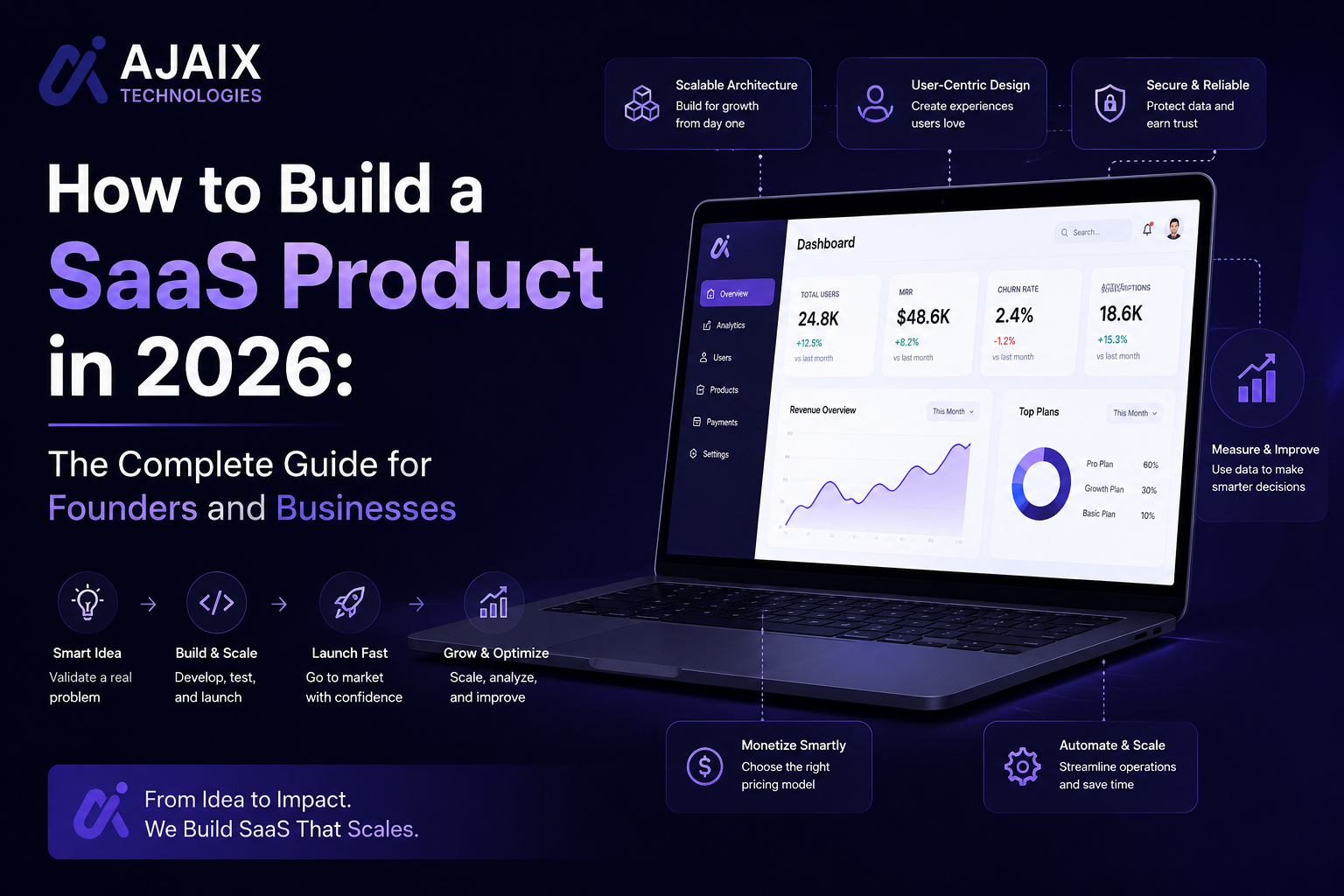
How to Build a SaaS Product in 2026: The Complete Guide for Founders and Businesses
Building a SaaS product in 2026 requires more than good code — it demands the right architecture, the right go-to-market strategy, and a development process designed to validate fast and scale confidently. This is the complete guide.
How to Build a SaaS Product in 2026: The Complete Guide for Founders and Businesses
The SaaS model remains one of the most compelling business models available to founders and established businesses alike. Recurring revenue, global distribution with near-zero marginal cost, and the compounding value of a growing subscriber base make a well-executed SaaS product one of the most valuable assets a technology business can own.
The challenge is that most SaaS products fail — not because the idea was bad, but because the execution missed critical decisions at the foundation. The wrong architecture chosen to save money early becomes a rebuild at the worst possible moment. The wrong feature set built before validation wastes months of runway on functionality that real customers do not need. The wrong development partner delivers something that technically works but cannot scale, cannot be maintained, and cannot evolve with the product.
In 2026, the tools, infrastructure, and knowledge available to SaaS founders are better than they have ever been. But the fundamentals that determine success have not changed: validate the problem, architect for scale, build incrementally, and ship to real users as fast as possible without accumulating technical debt that limits your future.
This guide covers every stage of that journey — from initial idea to launched, scaling SaaS product — with the technical depth and strategic clarity that actually helps founders make better decisions.
Table of Contents
- What Makes a SaaS Business Model Work
- Stage 1 — Idea Validation: Before You Write a Line of Code
- Stage 2 — Defining Your MVP: The Smallest Thing That Delivers Real Value
- Stage 3 — SaaS Architecture: The Decisions That Determine Everything
- Stage 4 — Choosing Your Technology Stack
- Stage 5 — Authentication, Multi-Tenancy, and User Management
- Stage 6 — Subscription Billing and Pricing Architecture
- Stage 7 — Building the MVP: Development Process and Best Practices
- Stage 8 — Security, Compliance, and Data Privacy
- Stage 9 — Launching Your SaaS Product
- Stage 10 — Post-Launch: Measuring, Iterating, and Scaling
- Common SaaS Development Mistakes to Avoid
- How Much Does It Cost to Build a SaaS Product in 2026?
- Why Ajaix Technologies for Your SaaS Build
- Frequently Asked Questions
1. What Makes a SaaS Business Model Work {#what-makes-saas-work}
Before diving into how to build a SaaS product, it is worth being clear about what makes the model work — because the business fundamentals should shape every technical and product decision you make.
The SaaS Value Proposition
A SaaS product charges customers a recurring fee — monthly or annually — in exchange for ongoing access to software that solves a specific, persistent problem. The model works when three conditions are met:
The problem is recurring. SaaS is the wrong model for one-time needs. It is the right model for problems customers face continuously — every day, every week, every month — and that your software addresses better than any alternative.
The value delivered exceeds the subscription cost by a clear margin. Customers renew when the software saves them more in time, money, or risk than the subscription costs. The larger that margin, the stronger the retention.
The cost to serve additional customers is low relative to the revenue they generate. SaaS economics work because the same codebase serves thousands of customers — marginal cost of a new customer is infrastructure and support, not development. Protect this unit economics advantage in every architectural decision you make.
The Metrics That Matter
SaaS businesses are measured by a specific set of metrics that reflect the health of the recurring revenue model: Monthly Recurring Revenue (MRR), Annual Recurring Revenue (ARR), Customer Acquisition Cost (CAC), Customer Lifetime Value (LTV), churn rate, and Net Revenue Retention (NRR). Understanding these metrics from the start shapes the product, pricing, and development decisions that determine whether the business works.
2. Stage 1 — Idea Validation: Before You Write a Line of Code {#idea-validation}
The most expensive mistake in SaaS development is building a product nobody wants — or building the wrong version of a product people want. Idea validation is how you avoid this mistake, and it should happen before any development investment is made.
The Problem Validation Questions
Start with the problem, not the solution. Before defining your product, validate the problem:
- Is the problem real? Can you find ten people who experience this problem regularly and describe it in their own words — without prompting?
- Is it painful enough to pay to solve? People have many problems. They pay to solve the ones that cost them significantly in time, money, or risk. How does yours rank?
- Is the existing solution genuinely inadequate? If good solutions already exist, you need a specific reason why yours will be meaningfully better — not just different.
- Can you reach the people who have this problem? A real problem with no accessible customer acquisition channel is not a viable SaaS business.
Validation Before Development
Validate your idea without code. Talk to potential customers — not to pitch your solution, but to understand their problem in depth. Run a landing page experiment to measure genuine interest (email sign-ups or pre-orders are real signals; pageviews are not). Offer a manual or concierge version of the solution to a small number of early customers before automating it in software. Use what you learn to sharpen the problem definition and solution hypothesis before committing to development investment.
The goal is to arrive at the development stage with validated evidence that real people have a real problem and would pay a specific amount for a specific solution — not with an assumption.
3. Stage 2 — Defining Your MVP: The Smallest Thing That Delivers Real Value {#defining-mvp}
A Minimum Viable Product in the SaaS context is not a rough prototype or a demo. It is the smallest, most focused version of your product that solves the core problem well enough for real customers to pay for it and use it regularly.
The MVP Scoping Process
Start with a comprehensive list of every feature you believe the product needs. Then apply the following filter to each item:
- Core value features: Features without which the product cannot solve the core problem. These belong in the MVP.
- Retention features: Features that meaningfully improve the experience of existing users. These belong in the MVP if they are essential to retention, or in phase two if they are enhancements.
- Acquisition features: Features primarily valuable for marketing or onboarding. Almost always phase two.
- Nice-to-have features: Features that would be good to have but do not materially affect whether customers adopt and retain the product. Always phase two or later.
A typical MVP scoping process removes 40–60% of initially planned features from the first release — without reducing the product's ability to acquire and retain its first customers.
What Your MVP Must Do Well
Whatever scope you define for the MVP, it must execute its core function reliably, securely, and to a standard that makes paying customers feel confident. An MVP is smaller in scope than a fully featured product — it is not lower quality within that scope. A buggy, insecure, or unreliable MVP does not validate your product idea — it contaminates the signal with execution problems.
4. Stage 3 — SaaS Architecture: The Decisions That Determine Everything {#saas-architecture}
Architecture decisions made at the start of a SaaS project have consequences that last for the entire life of the product. Getting these right is one of the most important investments a SaaS founder can make — and one of the areas where experienced guidance delivers the most value.
Single-Tenant vs Multi-Tenant Architecture
This is the most fundamental SaaS architecture decision.
Single-tenant architecture gives each customer their own isolated instance of the application — their own database, their own server resources, their own deployment. Maximum isolation, simpler security model, but significantly higher infrastructure cost per customer and higher operational complexity at scale.
Multi-tenant architecture serves all customers from a shared application instance, with data isolation handled at the application and database level. Lower infrastructure cost per customer, simpler operations at scale, and faster feature deployment — but requiring more careful data isolation design and a more sophisticated application architecture.
For most SaaS products, multi-tenant architecture is the right default — it is what enables the unit economics that make SaaS financially viable. Single-tenant makes sense for enterprise customers with strict data isolation requirements or compliance mandates, and is often offered as a premium tier rather than the baseline architecture.
Monolith vs Microservices
For early-stage SaaS products, a well-structured monolithic architecture is almost always the right starting point. A monolith is faster to build, easier to deploy, and simpler to debug than a microservices architecture — and the operational complexity of microservices is unnecessary overhead at the scale of an early SaaS product.
Build a clean, well-organized monolith first. Extract services as specific scaling or team organization requirements make them genuinely necessary. The engineering discipline that produces a maintainable monolith is the same discipline that produces maintainable microservices — the architecture change is straightforward when the time is right.
API-First Design
Design your SaaS application with a clean API layer from the start — even if you are not building a public API on day one. API-first architecture enables flexible frontend choices (web, mobile, third-party integrations), makes the application extensible without architectural surgery, and sets you up for the integrations and partner ecosystem that drive SaaS growth.
Data Architecture
Your data model is one of your most critical and most permanent architectural decisions. A poorly designed data model is expensive and disruptive to change once the product is in production with real customer data. Invest time in getting it right before development begins — model the real-world entities and relationships your product manages, design for the queries your application will actually run, and plan for the data growth that success will bring.
5. Stage 4 — Choosing Your Technology Stack {#technology-stack}
Technology stack choices for a SaaS product should be driven by three factors: the expertise of your development team, the specific technical requirements of your product, and the long-term productivity and maintainability of the chosen technologies.
Proven SaaS Technology Stacks in 2026
React / Next.js + Node.js + PostgreSQL The most widely adopted full-stack JavaScript combination for SaaS in 2026. Strong ecosystem, large talent pool, excellent tooling, and Next.js's server-side rendering capabilities make this stack well-suited for both the marketing site and the application itself. PostgreSQL is one of the most capable and reliable relational databases available.
React / Next.js + Laravel + MySQL / PostgreSQL An excellent choice for teams with PHP expertise or projects that benefit from Laravel's rich built-in feature set — authentication, queues, notifications, and more. Laravel's opinionated structure accelerates development significantly for CRUD-heavy SaaS applications.
Next.js + Python (FastAPI or Django) + PostgreSQL Well-suited for SaaS products with significant data processing, machine learning, or AI integration requirements. Python's data ecosystem is unmatched, and FastAPI delivers excellent API performance with strong type safety.
React Native or Flutter + Backend API For SaaS products where mobile is the primary interface, these cross-platform frameworks allow a single codebase to target both iOS and Android, reducing development cost significantly compared to native development for each platform.
Infrastructure Stack
Regardless of application stack, the infrastructure choices in 2026 are relatively standardized for SaaS:
- Cloud platform: AWS, Google Cloud, or Microsoft Azure — all capable, with specific strengths depending on your requirements
- Containerization: Docker for consistent deployment environments
- Orchestration: Kubernetes for production at scale (overkill for early stage — start with managed container services)
- Database hosting: Managed database services (AWS RDS, Google Cloud SQL) for automated backups, patching, and scaling
- CDN: Cloudflare or AWS CloudFront for global performance and DDoS protection
- Monitoring: Datadog, New Relic, or the cloud platform's native monitoring tools
6. Stage 5 — Authentication, Multi-Tenancy, and User Management {#auth-multi-tenancy}
Authentication and multi-tenancy are the technical foundations of a SaaS product — and getting them right from the start avoids expensive retrofitting later.
Authentication Requirements for SaaS
A production SaaS authentication system in 2026 must support:
- Email and password authentication with secure password hashing (bcrypt or Argon2)
- Social login (Google, Microsoft, GitHub) — increasingly expected by enterprise users
- Single Sign-On (SSO) via SAML or OIDC — essential for enterprise customers using identity providers like Okta, Azure AD, or Google Workspace
- Multi-Factor Authentication (MFA) — mandatory for any security-sensitive product, and increasingly expected by enterprise buyers
- API key authentication for programmatic access if your product has an API
- Invitation-based team onboarding — users should be able to invite colleagues to their account without requiring administrator involvement
Consider using an established authentication service — Auth0, Clerk, or AWS Cognito — rather than building authentication from scratch. These services handle the security-critical implementation details correctly, support enterprise SSO out of the box, and reduce the development time and ongoing maintenance burden significantly.
Multi-Tenancy Implementation
In a multi-tenant SaaS application, every data record must be associated with the correct tenant — and absolutely no data must ever be accessible to the wrong tenant. This isolation must be enforced at every layer: the application logic, the database queries, and the API responses.
Common multi-tenancy implementation approaches:
Row-level tenancy: All customers share the same database tables, with each row tagged with a tenant identifier. Simple to implement, most cost-effective for early stage. Requires disciplined query filtering at every database access point.
Schema-level tenancy: Each customer gets their own database schema within a shared database server. Stronger isolation than row-level, easier to back up and restore individual tenants, moderate infrastructure cost.
Database-level tenancy: Each customer gets their own database instance. Maximum isolation, highest infrastructure cost. Usually reserved for enterprise tiers.
Role-Based Access Control
Design your permission system before building the first feature. Most SaaS products require at minimum: an owner role (full access, billing management), an admin role (user management, configuration), and a member role (core product access). Enterprise customers often require custom roles. Retrofitting a permission system onto a product that was built without one is a significant and disruptive undertaking.
7. Stage 6 — Subscription Billing and Pricing Architecture {#billing-pricing}
Billing is not a feature you add at the end — it is a core system that shapes how your product is structured, how users experience it, and how your business operates. Design it deliberately from the start.
Use a Billing Platform — Do Not Build Your Own
Subscription billing is complex: recurring charges, trials, upgrades, downgrades, proration, failed payment handling, dunning management, invoicing, tax calculation, refunds, and the different rules that apply in different jurisdictions. Building this correctly from scratch is a significant engineering investment that delivers no competitive advantage.
Stripe is the industry standard for SaaS billing in 2026 — well-documented, reliable, with a comprehensive feature set that covers everything most SaaS products need. Paddle is an excellent alternative for products targeting international markets, as it acts as a merchant of record and handles sales tax and VAT compliance globally. Chargebee and Recurly are strong options for products with more complex billing requirements.
Pricing Model Considerations
Your pricing model is a product decision as much as a business decision. Common SaaS pricing models and when each works:
Flat-rate pricing: One price for all features. Simple to understand and communicate. Works best when your customer base is homogeneous and usage patterns are consistent.
Tiered pricing: Multiple plans with different feature sets and price points. The most common model — aligns price with perceived value at different customer segments.
Usage-based pricing: Customers pay based on how much they use (API calls, active users, data processed). Aligns cost with value delivered. Increasingly popular for infrastructure and AI products in 2026.
Per-seat pricing: Customers pay per user. Predictable for both parties, scales naturally with customer growth. Widely used for collaboration and productivity tools.
Hybrid pricing: A combination of seat-based and usage-based components. More complex to communicate but often the most accurate reflection of value delivered.
Design your pricing model to reflect the value your product delivers — not to minimize friction at signup. A pricing model that undercharges early customers is expensive to fix later.
8. Stage 7 — Building the MVP: Development Process and Best Practices {#building-mvp}
With architecture designed, stack chosen, and MVP scope defined, development begins. The process followed during this stage determines not just the quality of the MVP but the quality of everything built on top of it.
Development Workflow
Version control: Git with a structured branching strategy (GitFlow or trunk-based development) from day one. No exceptions.
Code review: Every change reviewed by at least one other developer before merging. Code review is the primary mechanism for maintaining code quality, sharing knowledge, and catching issues before they reach production.
Automated testing: Unit tests for business logic, integration tests for API endpoints, and end-to-end tests for critical user journeys. Test coverage is not optional — it is the mechanism that allows confident iteration.
Continuous Integration: Automated builds and test runs on every code push. Broken builds are fixed immediately — they are never merged forward.
Environment management: At minimum, development, staging, and production environments. All configuration via environment variables — never hardcoded credentials or environment-specific logic in code.
Continuous Deployment: Automated deployment to staging on every merge. Deployment to production on demand, with the confidence that automated testing provides.
Feature Development Process
For each feature, the process should follow a consistent sequence: written specification or user story → technical design → implementation → automated tests → code review → staging deployment → stakeholder review → production deployment. Skipping steps in this process under time pressure is the most reliable way to accumulate technical debt that slows all subsequent development.
Documentation
Document as you build — not after. API documentation, architecture decision records, environment setup guides, and deployment runbooks all have zero value when they do not exist and significant value when they do. The cost of writing documentation while the context is fresh is a fraction of the cost of reconstructing it later — or of the consequences of operating without it.
9. Stage 8 — Security, Compliance, and Data Privacy {#security-compliance}
Security is not a feature added before launch — it is a property of the architecture and development process that must be present from the first line of code. In 2026, customers expect it, regulators require it, and security incidents are more damaging than at any previous point.
Security Fundamentals for SaaS
OWASP Top 10 mitigation built into the development process — input validation, parameterized queries, output encoding, secure session management, and protection against common injection, XSS, and CSRF vulnerabilities.
Encryption: All data encrypted in transit (TLS 1.3 minimum) and at rest (AES-256). Encryption keys managed through a dedicated secrets management service — never hardcoded or stored in application configuration files.
Dependency management: Regular automated scanning for known vulnerabilities in dependencies. Tools like Dependabot, Snyk, or OWASP Dependency-Check integrated into the CI/CD pipeline.
Penetration testing: Before launch and regularly thereafter. An external security assessment identifies vulnerabilities that internal review misses.
Incident response plan: Before you launch, define what you do if a security incident occurs — who is responsible, how customers are notified, how the incident is contained and remediated. Having no plan when an incident occurs makes an already bad situation significantly worse.
Compliance Considerations
GDPR: If any of your customers or their users are in the European Union, GDPR compliance is mandatory. This means lawful basis for data processing, data subject rights (access, deletion, portability), data processing agreements with sub-processors, breach notification processes, and privacy-by-design principles in your architecture.
SOC 2: Increasingly required by enterprise customers as evidence of security and operational maturity. SOC 2 Type II certification is achievable for early-stage SaaS companies with the right processes in place — and worth pursuing if enterprise sales are part of your go-to-market.
Industry-specific compliance: Healthcare (HIPAA), financial services, and other regulated industries have specific compliance requirements that must be designed into the product architecture from the start.
10. Stage 9 — Launching Your SaaS Product {#launching}
A SaaS launch in 2026 is not a single event — it is a process. The goal of launch is not perfection; it is getting real customers using the product so that real learning can begin.
Pre-Launch Preparation
Onboarding flow: The first experience a new user has with your product determines whether they reach the "aha moment" — the point at which they understand the value of the product — or abandon it before getting there. Design and test your onboarding flow carefully before launch. Every step that is unclear, every friction point that is unnecessary, and every moment where a user does not know what to do next is churn waiting to happen.
Error monitoring: Tools like Sentry or Datadog APM configured and tested before the first real user touches the product. You need to know about errors before your customers report them.
Customer support infrastructure: How will customers get help when they need it? A support email address, a basic help documentation site, and a defined response time SLA are the minimum. Live chat (Intercom, Crisp) significantly improves early user retention by catching confused or stuck users before they churn.
Analytics: Event tracking configured to capture the user actions that matter — signups, activation milestones, feature usage, subscription events. You cannot improve what you cannot measure.
Launch Strategy
For most SaaS products, the right launch strategy is a controlled early access launch — inviting a small number of users (50–200) who represent your target customer profile, gathering intensive feedback, and iterating rapidly before opening to the broader market. This approach surfaces real problems in a controlled environment and gives you the signal you need to improve the product before scale amplifies any issues.
Product Hunt, relevant communities, and direct outreach to potential customers in your target market are the most effective early-stage distribution channels for most SaaS products. Paid acquisition makes sense when the onboarding-to-retention funnel is working — not before.
11. Stage 10 — Post-Launch: Measuring, Iterating, and Scaling {#post-launch}
The launch is not the end of the journey — it is the beginning of the most important phase. Post-launch execution determines whether your SaaS product grows into a sustainable business or plateaus after its initial traction.
The Metrics to Track From Day One
Activation rate: What percentage of new signups reach the key activation milestone — the point at which they have experienced the core value of the product? Low activation rates indicate onboarding problems.
Day 7 and Day 30 retention: What percentage of users who activated are still using the product 7 and 30 days later? Retention is the clearest signal of product-market fit.
Churn rate: What percentage of paying customers cancel each month? Monthly churn above 2–3% for SMB SaaS or 1% for enterprise SaaS indicates a product or value delivery problem that must be addressed before scaling acquisition.
Net Revenue Retention (NRR): Does your revenue from existing customers grow over time (through upgrades and expansion) faster than it shrinks (through churn)? NRR above 100% means the business grows even with zero new customer acquisition.
Customer Acquisition Cost (CAC) and LTV: Is the lifetime value of a customer a multiple of the cost to acquire them? A LTV:CAC ratio below 3:1 indicates that the business model needs work before scaling.
The Iteration Process
Post-launch iteration should be driven by data — product analytics showing where users drop off or disengage — and by direct customer feedback from interviews, support conversations, and in-product surveys. Build features that improve the metrics that matter. Resist the temptation to build features because they seem interesting or because a single vocal customer requested them.
Scaling Considerations
When the product is working — activation rates are strong, retention is high, and the unit economics are healthy — the conversation turns to scaling. Scaling a SaaS product involves scaling acquisition (paid channels, partnerships, content, sales), scaling the product (features that serve larger customers and new segments), and scaling the infrastructure (ensuring the application handles growth without degradation). Each of these is a distinct discipline, and each should be approached only when the foundation — a product that retains the customers it acquires — is solid.
12. Common SaaS Development Mistakes to Avoid {#common-mistakes}
Having worked on SaaS products across multiple industries, these are the mistakes we see most consistently — and they are almost always avoidable with the right guidance upfront.
Building Without Validation
Investing in development before validating that real customers have the problem you are solving and would pay your intended price to have it solved. Validation is cheap. Development is expensive. Do not reverse the order.
Over-Engineering the MVP
Building a comprehensive, enterprise-grade product for the first release when a focused, narrower product would validate the core hypothesis faster and at lower cost. The architecture should be scalable — the feature set should be minimal.
Ignoring Multi-Tenancy From Day One
Designing a single-user application and trying to retrofit multi-tenancy later. Multi-tenancy touches the data model, the authentication system, the billing integration, and the API design. Adding it after the fact is one of the most disruptive and expensive refactors a SaaS product can undergo.
Skipping Billing Design
Treating billing as an afterthought that can be bolted on before launch. Billing is a core system — design it as one.
Choosing the Wrong Development Partner
Selecting a development team on price alone, without evaluating their experience with SaaS-specific architecture requirements. A team without SaaS experience will make the architectural mistakes above and others — because they have not solved these problems before.
Not Measuring Retention
Focusing on acquisition metrics (signups, MRR growth) without measuring retention. A SaaS product with high acquisition and high churn is a leaky bucket — no amount of acquisition spending fixes a retention problem.
13. How Much Does It Cost to Build a SaaS Product in 2026? {#cost}
Cost is the question every founder asks — and the answer is genuinely dependent on scope, complexity, and the development team you choose. Here is an honest framework:
MVP Cost Factors
The cost of a SaaS MVP in 2026 is shaped by:
- Feature scope — the number and complexity of features in the MVP
- Authentication requirements — basic email/password vs enterprise SSO dramatically affects complexity
- Integration requirements — every third-party integration adds development time
- UI/UX complexity — a simple, functional interface costs less than a polished, design-intensive one
- Multi-tenancy approach — row-level tenancy is simpler than schema-level or database-level
- Compliance requirements — HIPAA, SOC 2, and GDPR compliance add significant architectural and documentation effort
- Development team location and experience — rates vary significantly by geography and team experience level
Realistic Cost Ranges
A focused SaaS MVP — covering core functionality, authentication, multi-tenancy, basic billing integration, and fundamental security — typically represents a meaningful but achievable development investment. With an experienced team working efficiently, a well-scoped MVP can be delivered in three to six months.
The most cost-effective approach is almost always: thorough discovery to sharpen the scope, aggressive prioritization to reduce the MVP to its true minimum, and a development partner with SaaS-specific experience who does not repeat the learning curve of architectural mistakes on your budget.
Total Cost of Ownership
Beyond the initial build, plan for: ongoing development (new features, improvements, integrations), infrastructure costs (which scale with usage), customer support, and security maintenance. For most early-stage SaaS products, infrastructure costs are modest until meaningful scale is reached — cloud-native architecture and managed services keep operational costs low in the early stages.
14. Why Ajaix Technologies for Your SaaS Build {#why-ajaix}
At Ajaix Technologies, we are a full-stack software development company based in Mansehra, Pakistan, specializing in high-performance web development, AI integration, and scalable enterprise architecture. SaaS product development is one of our core areas of expertise — and we bring a specific set of capabilities to every SaaS engagement.
SaaS-Specific Architecture Experience
We have designed and built multi-tenant SaaS architectures, implemented enterprise SSO and role-based access control systems, integrated Stripe and Paddle billing, and structured data models for SaaS products at scale. We do not learn these patterns on your project — we bring them to it.
MVP-First Discipline
We challenge every SaaS client to define the true minimum viable product — and we build that first, to production quality, before investing in additional features. This concentrates early budget on validated value and gets real customer feedback into the development process as quickly as possible.
Full-Stack Delivery
We handle the complete product: UI/UX design, frontend development, backend API, database architecture, third-party integrations, cloud infrastructure, CI/CD pipelines, security implementation, and post-launch support. One accountable team across the entire stack.
Competitive, Transparent Pricing
As a Pakistan-based development company, we offer rates that represent genuine cost savings compared to equivalent Western development teams — without compromise on engineering standards, SaaS architecture expertise, or delivery reliability.
Long-Term Partnership
We build SaaS products with the intention of being your long-term development partner — through MVP launch, iteration based on real user feedback, feature expansion, and scaling. The institutional knowledge we accumulate about your product and business makes us progressively more valuable over time.
Book a free SaaS product discovery session with the Ajaix Technologies team →
Bring your idea, your validation evidence, and your questions. We will give you an honest assessment of what it will take to build it, what it will cost, and how long it will take — with no pressure and no generic proposals.
15. Frequently Asked Questions {#faq}
How long does it take to build a SaaS MVP? A well-scoped SaaS MVP — covering core functionality, authentication, multi-tenancy, and billing integration — typically takes three to six months with an experienced development team. The discovery and architecture phase that precedes development takes two to four weeks and significantly improves the accuracy of this estimate.
Should I build my SaaS product or use a no-code platform? No-code and low-code platforms (Bubble, Webflow, etc.) can accelerate early validation for non-technical founders — but they impose significant limitations on scalability, customization, performance, and data ownership. For a product you intend to scale and own long-term, custom development delivers a foundation that no-code platforms cannot.
Do I need to build mobile apps alongside the web application? Not necessarily for the MVP. A responsive web application serves mobile users adequately for most SaaS use cases. Dedicated mobile apps make sense when the mobile context (offline use, device hardware access, push notifications) is central to the product's value proposition.
How do I handle data for different customer sizes on a multi-tenant system? Row-level tenancy handles small to mid-sized customers well. For large enterprise customers with very high data volumes or strict isolation requirements, schema-level or database-level tenancy — or a dedicated instance option offered as a premium tier — provides the isolation they require.
When should I offer a free trial vs a freemium tier? Free trials (full access for a limited time) work best when the product's value is clear within the trial period and activation is fast. Freemium (limited access indefinitely) works best when the product has genuine value at the free tier that creates a natural conversion path to paid. Freemium is significantly more expensive to operate and harder to convert — do not default to it without a clear freemium-to-paid conversion model.
How do I protect my SaaS idea during development? A strong non-disclosure agreement with your development partner, combined with code ownership terms that vest all IP to you, provides the primary legal protection. Operationally, the best protection for a SaaS idea is speed — get to market before anyone else has the chance to execute on the same insight.
What is the most important thing to get right in a SaaS product? Retention. A SaaS product that retains its customers is a compounding business. A SaaS product that acquires customers and loses them is an expensive treadmill. Build for retention from the first line of code — design the onboarding to reach activation fast, the core product to deliver recurring value, and the support experience to make customers feel looked after.
Your SaaS Product Starts With the Right Foundation
The SaaS products that succeed in 2026 are not the ones with the most features or the most sophisticated technology. They are the ones built on the right foundation — a validated problem, a deliberate architecture, a disciplined development process, and a relentless focus on delivering and measuring real value for real customers.
Every decision you make before and during the build either strengthens that foundation or undermines it. The stakes of getting these decisions right are high — and the good news is that with the right guidance, the right partner, and the right process, they are entirely within your control.
Start building your SaaS product with Ajaix Technologies →
Let's talk about your idea, your timeline, and how we can help you build something that lasts.
Ajaix Technologies — Engineering the Future. Based in Mansehra, Pakistan. Serving clients globally. ajaix.com · [email protected]